Tim Brown Chose a Life of Purpose
Published on June 08, 2026
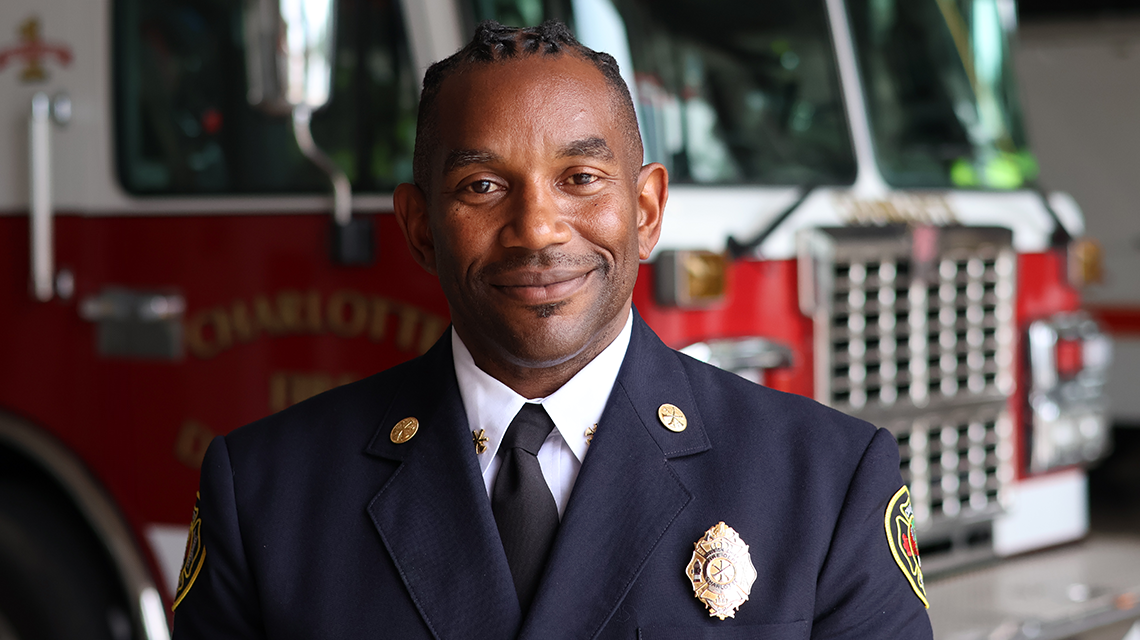
Tim Brown’s path to division chief began far from a firehouse, but has been guided by purpose, service and family.
When Timothy Brown stepped off a plane in Chicago after months of working in France, the pace hit him before he even left the airport.
People were rushing. The energy felt sharp. The rhythm was familiar, but suddenly exhausting.
Brown had spent years in corporate America as an IT consultant and software developer, traveling constantly, working long days and helping major companies modernize their technology systems. He had lived and worked in places such as France, Belgium, Canada, Kentucky, Dallas, Cleveland and Detroit. He was young, successful and building the kind of career many people chase.
Then France slowed him down long enough to see something different.
The people around him worked hard, but they protected their time. Dinners lasted hours. Family, space and life outside work mattered. At first, Brown resisted it. He was used to working 10, 12 and 14 hours a day. Then, slowly, the lesson settled in.
“They would tell me, ‘Brown, you live to work,’” Brown said. “They said, ‘No, we work to live.’”
Brown reflects on the moment he realized he wanted his work to mean something more.
When Brown returned to the United States, the rush of the airport felt like the same pace he had been keeping for years. He found a corner, slid down the wall and sat there.
“I can’t do this anymore,” he remembered thinking. “It’s over.”
More than two decades later, Brown still works with urgency. But now that urgency is tied to service, leadership and making sure the work he does has a lasting impact.
After 23 years with Charlotte Fire, Brown is being promoted from Battalion Chief to Division Chief, stepping into a role that expands his leadership across the department and continues a career built on accountability, family, fairness and a deeply personal belief that the work should always mean something.
For Brown, the promotion is not about a title. It is about reach.
“I want to be able to look back and say I’ve done something that helped somebody else,” Brown said. “What I do makes a difference out here.”
Tim Brown stands with Fire Chief Reginald Johnson following his promotion to division chief.
“Tim Brown has built his Charlotte Fire career on service, accountability and a genuine commitment to people,” Fire Chief Reginald Johnson said. “He understands that leadership is not about a title. It is about taking care of firefighters, making sound decisions and ensuring every person in this city receives the same level of care and respect. As he steps into the role of division chief, I know he will continue to lead with purpose and make a lasting impact on this department and the community we serve.”
Brown grew up on the West Side of Chicago with his parents, Robert and Anita Brown, his brother, Robert Brown, and his sister, Angela Brown. His father drove a garbage truck, and Brown remembers riding with him as a child and loving the work. It left an impression strong enough that, years later, after college and corporate America, Brown told his father he wanted to come work with him.
His father said no.
Brown had earned a degree in computer science from Morehouse College in Atlanta, a historically Black men’s college located near Spelman College and Clark Atlanta University. His father wanted him to use that education.
Brown had done exactly that. After graduating in 1995, he joined PricewaterhouseCoopers Consulting and entered the world of corporate technology. He became a software developer and data conversion lead, writing code and helping companies move from older green-screen systems into modern graphical interfaces.
He enjoyed the challenge. He enjoyed solving problems. He enjoyed building systems and finding logical solutions.
Brown’s leadership style is shaped by accountability, direct conversations and care for his crews.
But once he decided to leave that world, Brown turned toward work he believed he could enjoy for the rest of his life. If he could not drive a truck with his father, he knew what came next.
“I’ve always wanted to be a firefighter,” Brown said.
At the time, Charlotte still felt like a smaller city to him. Ballantyne was not what it is today. The department was hiring, and Brown applied.
The process quickly tested how serious he was.
While working in Belgium, Brown received word from his mother that a letter from Charlotte Fire had arrived. He had an interview later that week. He had just flown overseas, but he got back on a plane and returned to Charlotte.
He walked into the interview wearing jeans, a muscle shirt, a full goatee and an earring. Everyone else was dressed in suits.
Brown knew how it looked, so he explained himself. He had come straight from Belgium. Those were the clothes he had with him. He did not know he could reschedule, and he was not going to miss the opportunity.
One of the interviewers asked to see his passport. Brown had it with him. The interviewer flipped through the pages, saw the stamp and realized Brown had flown back for the interview.
“You were serious about being here,” Brown recalled him saying.
Brown was.
Brown’s career with Charlotte Fire began with learning the job from the ground up.
He was hired by Charlotte Fire and started Jan. 27, 2003.
The transition was not easy. Brown had no fire service background. Some recruits came from volunteer fire departments and already understood the language, culture and expectations. Brown had to catch up quickly.
He asked questions. He studied the craft. He leaned into the challenge.
That has been a pattern throughout his life.
Brown said he has always been drawn to challenges, whether academic, physical, professional or personal. Growing up in Chicago, graduating from Morehouse, working in corporate America and entering a profession where he had to learn everything from the ground up all required the same internal drive.
“I love a challenge,” Brown said. “I love a physical challenge. I love anything that says, ‘Will you be able to achieve and succeed in this?’”
His recruit class also stood out because firefighters arrived with different backgrounds and life experiences. Brown had no fire service background, so he focused on learning the craft, asking questions and proving himself through preparation and effort.
He said that mindset has stayed with him throughout his career.
“There’s always that challenge to overachieve,” Brown said. “You can’t just be as good. You’ve got to try to be better.”
For Brown, that drive was never only about advancement. It was about earning trust, building strong crews and showing younger firefighters that they should take ownership of their careers.
Brown’s Charlotte Fire career spans more than two decades of emergency response and leadership.
Brown did not wait for someone else to map out his future. He learned early that seniority, preparation and work ethic mattered, but so did the willingness to make decisions about his own path.
He now shares that lesson with younger firefighters, especially those who may feel uncertain about where they belong or what opportunities they should pursue.
“Don’t let anybody drive your career,” Brown said. “You drive your career.”
He said he has had that conversation many times with firefighters who were unsure whether they should pursue certain assignments.
Brown’s message is simple. If the move helps them grow, and if it supports their goals, they should pursue it.
“Where do you want to be?” Brown said. “If this is what you want, and this is going to help you achieve the goals you have in mind, you put in for what you want and go there.”
Brown’s career has moved from the firehouse floor to department leadership.
That same philosophy shaped Brown’s own assignments. He said he has never been interested in jumping through hoops just to pad a resume. He moved toward places that challenged him, made sense for his life or allowed him to serve in the way he believed was right.
As a captain, he focused on taking care of his crew. As a battalion chief, he focused on taking care of his battalion. As a division chief, he sees an opportunity to support more people, make decisions at a higher level and continue shaping the culture of the department.
Leadership, to Brown, is not about status. It is about responsibility.
“If you’re a leader, you take the hits but you give the praise,” Brown said. “The hits come, you protect your people from that. When things go great, you pass that right down to the people who did it.”
He believes leaders should correct people when needed, but not embarrass them. They should accept responsibility when things go wrong, but not take credit that belongs to their crews.
“Our job as leaders, whether you’re a captain, a BC, a division chief or deputy, is to make sure people below you can do your job,” Brown said. “Our job is to take care of the people of Charlotte, but also to take care of your people.”
Brown and Battalion Chief Davies monitor operations during an emergency response.
That belief connects directly to one of the strongest themes of Brown’s career: people deserve consistency, respect and professionalism on every call.
Brown said the standard should never change based on where a call happens, what time it is or who needs help. Whether he was leading a crew, managing a battalion or supporting firefighters in the field, he expected the work to be done the right way.
For Brown, that means showing up with empathy, making sound decisions and remembering that every call matters to the person who made it.
Brown works at a fire scene during his years leading Charlotte Fire crews in the field.
That is the work Brown says he is willing to keep doing.
He left corporate America because the work no longer gave him the life he wanted. He joined Charlotte Fire because he wanted to do work that helped people. Now, as he moves into a division chief role, the same purpose remains.
The promotion comes at a meaningful time in Brown’s personal life as well.
At 53, he is a new father. His son, Therun Alexander Brown, will turn 11 months old in June. Brown said fatherhood has been one of the most amazing experiences of his life.
“I am super happy and proud to be a father,” Brown said. “I love this journey.”
Brown celebrates his promotion with family, the foundation he says has supported him throughout his life.
His fiancée, Allison Fredericks, his parents, and his sister were part of the moment as Brown steps into the new role. Family, he said, has always been his foundation.
His parents moved from Chicago to the Charlotte area years ago after Brown asked them to come. They now live in Indian Land, South Carolina, and Brown said wherever he goes from this point forward, they go with him.
“They sacrificed so much for me, my brother and my sister,” Brown said. “I owe them everything.”
Brown also describes longtime friends and colleagues as part of his extended family, including people who have supported him throughout his life and career. Faith and family, he said, remain central to who he is.
Brown says faith and family remain central to who he is and how he leads.
That foundation helps explain why Brown’s leadership style is both direct and deeply personal. He is not afraid of conflict. He does not shy away from difficult conversations. He admits that can be both a strength and a weakness, but he also believes honest conversations are sometimes necessary to protect people, improve systems and push the department forward.
He has spent his Charlotte Fire career building crews, challenging expectations and insisting that the work means more when it is done for the right reasons.
Brown said he would have been happy remaining a battalion chief. He loved the role, loved the work and loved the people he served alongside. The promotion matters not because he needed it, but because it gives him another way to contribute.
“I want to be able to make decisions that are mine to make,” Brown said. “I want to make the process that I think is going to help.”
Brown wears the white chief officer cap that marks his promotion to division chief.
That work now continues at a higher level.
Brown’s path to division chief did not begin in a firehouse. It began in Chicago, moved through Morehouse, passed through corporate boardrooms and international assignments, paused in a crowded airport and turned toward Charlotte Fire when he decided he wanted his life’s work to mean something more.
He still works hard. He still expects a lot of himself. He still expects a lot from the people around him.
But the purpose is clear.
It is not about chasing the next paycheck or the next project in another city. It is about helping people who may never know his name. It is about making sure firefighters are supported. It is about providing consistent service across Charlotte and helping shape the department for the people who will lead it next.
Brown says the work remains focused on helping people who may never know his name.
For Brown, that is the work worth doing.
And as he becomes Division Chief Tim Brown, that work is far from finished.