Seeking the Truth After the Fire
Published on October 03, 2026
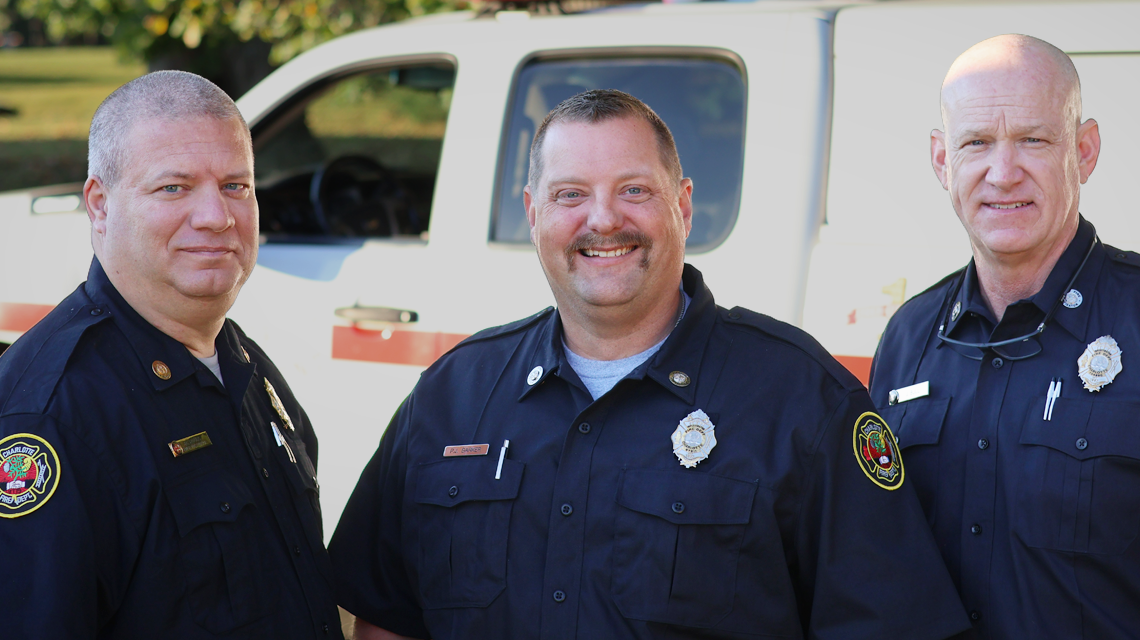
From left, Charlotte Fire investigators Jason Boggs, Patrick Barker and John Bull hold the top three leadership positions in the North Carolina chapter of the International Association of Arson Investigators.
By Kevin Campbell, Charlotte Fire
When the flames are out, the hoses are packed and most people have left the scene, Charlotte Fire investigators are often just beginning their work.
They enter structures blackened by smoke and fire, dig through debris and study damage that can appear chaotic to almost anyone else. At the same time, they may be interviewing people who have just lost a home, their belongings or someone they love, trying to gather the information they need while recognizing the weight of what those people have just experienced.
Somewhere in what remains, they are looking for the truth.
“I still enjoy seeking the truth and trying to figure out why someone has set a fire,” said Jason Boggs, a senior fire investigator with Charlotte Fire.
For Boggs and fellow Charlotte Fire investigators John Bull and Patrick Barker, that search extends well beyond individual fire scenes. The three currently hold the top three leadership positions in the North Carolina chapter of the International Association of Arson Investigators, placing Charlotte Fire personnel in prominent roles within an organization dedicated to advancing the profession across the state.
Bull serves as president, Barker as first vice president and Boggs as second vice president.
The International Association of Arson Investigators is a professional association for fire, arson and explosion investigators that provides education, training, professional development, certification, networking and other resources to people working in the field.
Bull said the North Carolina chapter is the largest of roughly 75 chapters worldwide, and much of its work centers on providing training to investigators throughout the state.
For Charlotte Fire, having the chapter’s three top leaders working within its Fire Investigation Task Force brings decades of experience and different professional backgrounds together in one place.
Bull, a fire and explosion investigator on C shift, has worked in the field for more than 30 years. Before joining Charlotte Fire, he spent much of his career in the private sector and eventually retired as a fire and explosion investigator with North Carolina Farm Bureau.
Fire investigation was not a career he initially planned to pursue. His interest developed over time as he worked alongside experienced investigators, including mentors who had retired from agencies such as the State Bureau of Investigation and the Bureau of Alcohol, Tobacco, Firearms and Explosives.
Charlotte Fire investigator John Bull has worked in fire and explosion investigation for more than 30 years and serves as president of the North Carolina chapter of the International Association of Arson Investigators.
Those investigators taught him to look at a burned structure differently. What may appear to the average person as little more than catastrophic damage can contain a series of small details that, when properly interpreted, begin to explain what happened.
“To the average eye,” Bull said, the destruction may seem overwhelming, but investigators are trained to recognize the smallest details and understand how they contribute to the story of the fire.
Bull compares the process to putting together a puzzle. Investigators begin with a damaged scene and work piece by piece to determine where the fire originated and, when possible, what caused it. Not every piece will always be available, he said, but investigators can often recover enough information to develop a reliable picture of what occurred.
The work is methodical, but the environment in which it takes place is often difficult. Investigators may spend hours inside burned structures, digging through ash and debris, evaluating fire patterns and searching for evidence. Bull readily describes it as dirty and hazardous work, yet the physical conditions are only part of what investigators must navigate.
They are also dealing with people who may be experiencing one of the most devastating moments of their lives.
Boggs said empathy is essential because investigators often need information from victims while those same people are still trying to comprehend what has happened.
“You have to have empathy and understanding where they’re at at that moment,” he said.
Sometimes that means an investigator’s first concern is not immediately asking questions about where the fire began or what someone saw. Boggs said it may be more important first to make sure a resident has clothing, money or other belongings needed to get through the night, then sit down and begin gathering information once the person is in a better position to talk.
“Taking time to sit down with them, not just, ‘Hey, I need to get this information right now,’” Boggs said, can make a significant difference in how investigators approach an interview.
Charlotte Fire senior fire investigator Jason Boggs said empathy and understanding are essential when investigators work with people who may have just experienced a devastating loss.
That balance between compassion and investigation is critical because the answers investigators uncover can matter long after the fire scene has been cleared.
Barker said fire investigators regularly encounter people after the loss of property, a home or, in some cases, a loved one. There is nothing an investigator can do to reverse that loss, but determining why a fire happened can sometimes provide something the victims did not have before: an answer.
“If we can give them some type of justice or some type of answer to why that fire happened, that is what we can do for them,” Barker said.
Those answers can take different forms. An investigation may identify evidence of a crime, reveal a malfunctioning product or uncover information that could help prevent a similar fire from happening to someone else. While an explanation cannot replace what was lost, Barker said understanding what happened can provide families with some measure of closure.
Barker joined Charlotte Fire after a career that exposed him to several sides of the profession. He earned an associate degree in fire science and a bachelor’s degree in fire investigation, then completed an internship with the West Virginia State Fire Marshal’s Office.
He had originally envisioned becoming a firefighter, but that internship changed the direction of his career. Once he was exposed to fire investigation, Barker said he “got the bug for it.”
Over roughly two decades, he went on to work with the West Virginia State Fire Marshal’s Office and spent 11 years investigating fires in the private insurance industry before coming to Charlotte Fire.
“If you like puzzles, you like figuring stuff out and you’re very inquisitive,” Barker said, fire investigation can be a natural fit.
Charlotte Fire investigator Patrick Barker brings roughly two decades of fire investigation experience spanning the public and private sectors. He serves as first vice president of the North Carolina chapter of the International Association of Arson Investigators.
Boggs can trace his interest in fire investigation to a single fire early in his career as a firefighter with the Hickory Fire Department.
While working with Hickory Fire, he responded to an apartment fire and encountered a woman standing outside who directed firefighters to the apartment involved. Boggs asked how she knew where the fire was.
“She said, ‘Because I set it,’” he recalled.
The fire stemmed from a domestic dispute, and the encounter became Boggs’ first exposure to what he described as the criminal mind behind intentionally set fires. He had been out of recruit school only about six months, and the experience stayed with him. In 2003, he began taking fire investigation classes and eventually moved from operations into inspection and investigation work before joining Charlotte Fire in 2018.
His involvement with the North Carolina chapter of the IAAI grew from the same training opportunities that had helped shape his own career.
Boggs said there were relatively few places to obtain specialized fire investigation training when he entered the field, and the North Carolina chapter was one of the organizations providing it. After years of attending training and earning certifications, he began serving on the chapter’s training committee and helping organize opportunities for newer investigators. He later joined the board and was elected second vice president.
That emphasis on training is a common thread among all three investigators.
John Bull works with fellow Charlotte Fire investigators during training. Bull, Barker and Boggs also use their leadership roles with the North Carolina chapter of the International Association of Arson Investigators to help advance training and professional development in the field.
Bull said educating fire investigators across North Carolina is one of the chapter’s largest responsibilities, while some members also teach nationally and internationally. Bull himself said he is scheduled to teach in Dubai later this year.
Barker said staying current is particularly important in a profession where technology, building materials and potential ignition sources continue to change. He pointed to lithium-ion batteries as one example of an issue investigators increasingly must understand, both to properly investigate fires and to share that knowledge with others entering the profession.
For Barker, having expertise also creates a responsibility to pass it on. If experienced investigators are unwilling to share what they have learned with newer members of the profession, he said, the entire field suffers.
That responsibility connects the work of the state association directly to what Bull, Barker and Boggs do in Charlotte. Their leadership positions may be outside their regular duties with Charlotte Fire, but the purpose is closely related: developing better investigators who are prepared to approach fire scenes carefully, follow the evidence and understand the consequences their work can have for the people involved.
Every investigation begins with questions. Investigators need to determine where a fire started, what caused it, whether it was accidental or intentional, whether the same circumstances could cause another fire and, when a crime is involved, who may be responsible.
Fire can destroy much of the evidence needed to answer those questions, which is why investigators are trained to recognize what remains, understand the significance of details others might overlook and piece those details together without reaching beyond what the evidence supports.
For the people whose lives have been changed by a fire, that work can provide more than the findings contained in an investigative report. It can bring understanding to an event that may otherwise seem inexplicable, lead to accountability when a crime has occurred and identify hazards that could prevent someone else from suffering the same loss.
For Bull, Barker and Boggs, that is ultimately what the work comes back to: finding answers and, whenever the evidence allows it, finding the truth.