On Valentine’s Day, a Life Saved Meets the Firefighter Who Helped
Published on February 14, 2026
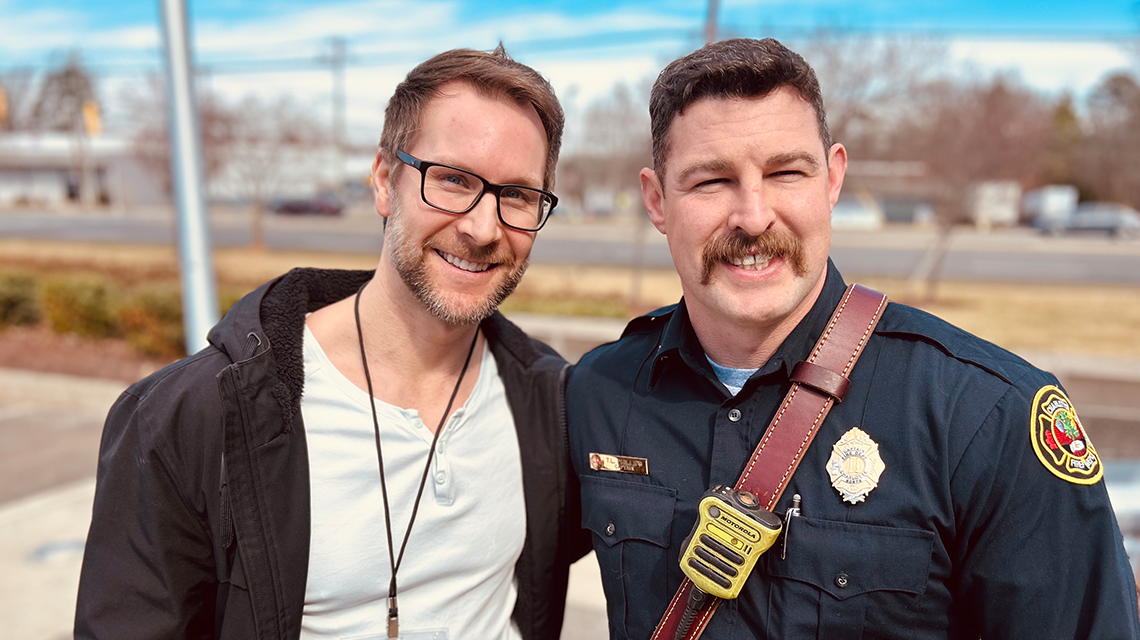
Kurt Rosalik and Captain Travis Phillips reunite outside the event. Phillips was part of the Charlotte Fire response team that restored a pulse after Rosalik’s cardiac arrest.
By Kevin Campbell, Charlotte Fire
On a day centered around hearts, flowers and handwritten cards, the most meaningful greeting inside a Charlotte gathering room Saturday afternoon did not involve a bouquet.
Captain Travis Phillips stood face to face with Kurt Rosalik, a husband and father who, just days before the new year, collapsed inside his home and went into cardiac arrest. His heart stopped. He was not breathing. His wife, eight and a half months pregnant, called for help while trying to perform CPR.
Now, on Valentine’s Day weekend, Rosalik returned with his wife, Polyana, and their infant daughter, Lana, to reunite with Phillips, the Charlotte Fire captain who helped lead the resuscitation effort that gave him another chance at life.
For Charlotte Fire, the moment was more than emotional. It was a reminder of what is possible when training, teamwork and immediate action come together, and it reflected a system that consistently produces strong results in CPR saves.
At about 2:11 a.m. on Dec. 29, 2024, emergency responders were dispatched to a cardiac arrest. Dispatch notes show the caller reported her husband was on the floor and not breathing. Before firefighters arrived, Polyana Rosalik performed CPR on her husband for approximately 12 minutes on her own while speaking with dispatchers.
Engine 8, led that night by Captain Anthony Perez, arrived and immediately took over patient care. Captain Travis Phillips was assigned to Firehouse 8 that shift and was part of the responding crew. Firefighters moved quickly into defined roles, initiating high-quality compressions, rhythm checks and defibrillation when indicated.
Kurt Rosalik shares a moment with Captain Travis Phillips during Saturday’s Cardiac Survivors Event. Phillips helped lead the resuscitation effort after Rosalik collapsed at home on Dec. 29, 2024.
Phillips said the crew settled into the disciplined rhythm they train for.
“We continued with some really good teamwork CPR,” he said. “We got Kurt loaded up and headed to the hospital. We knew he was breathing. We knew he had a blood pressure and a pulse.”
As is often the case, firefighters left the hospital without knowing the final outcome.
“We didn’t really get a story on the backside until a couple shifts later when we were able to reach out and figure out that he survived,” Phillips said. “Today we’re just getting a chance to catch back up and see how they’re doing.”
Lana Rosalik attends the Cardiac Survivors Event with her family. Born shortly after her father’s cardiac arrest, she is a sweet reminder of the life restored that December night and the future made possible because he survived.
Battalion Chief Rob Fitzgerald said one of the key milestones in a cardiac arrest response is ROSC, return of spontaneous circulation.
“ROSC stands for return of spontaneous circulation,” Fitzgerald said. “Basically, they got a pulse. We got a pulse back on the patient.”
Fitzgerald said Charlotte Fire has emphasized a team approach with continuous compressions and clearly defined responsibilities, reinforced through regular training.
“We do in person training twice a year on CPR, and they get it in online training as well,” he said. “We want it to be a well choreographed incident. Each firefighter on the truck has a specific role.”
In the field, Fitzgerald said, the focus is on minimizing interruptions.
“I think a lot of it comes down to continuous compressions,” he said. “We stop quickly, defibrillate if it’s indicated, and then we’re right back on the chest. If you stop CPR frequently, the outcome being positive decreases significantly.”
Members of Charlotte Fire stand together in front of their apparatus prior to the Cardiac Survivors Event, where firefighters reunited with individuals whose lives were saved through CPR and coordinated emergency response.
Fitzgerald said the department’s performance has been strong on a national scale, a reflection of consistent training, operational discipline and a culture that treats CPR as a core skill, not an occasional task.
For many firefighters, the most difficult part of a cardiac arrest call is not the work itself, but the silence that often follows. Outcomes are not always known, and privacy laws limit what can be shared.
That is why reunions, when they happen, can be powerful.
“It’s awesome when you get the other half of the story,” Phillips said. “A lot of times we put in a lot of really hard work and we don’t ever really get an answer on what happens after we drop them off at the hospital.”
Polyana Rosalik stands alongside Captain Travis Phillips while holding her daughter, Lana, during the Cardiac Survivors Event. Phillips helped lead the CPR effort that restored a pulse after Kurt Rosalik’s cardiac arrest just weeks before Lana was born.
In March 2025, Kurt and Polyana visited Firehouse 8 during Captain Anthony Perez’s shift to thank the crew who responded that night. Phillips, who had been assigned to Firehouse 8 on the night of the call but is not permanently stationed there, later reconnected with the family during Saturday’s Cardiac Survivors Event.
“It’s awesome when you get the other half of the story,” Phillips said.
The story they brought with them was even bigger than survival. Rosalik collapsed at home while his wife was nearing the end of her pregnancy. Their daughter was born shortly after, while he was still recovering.
“She was eight and a half months pregnant whenever he collapsed at home,” Phillips said. “They had the baby very shortly after, actually while Kurt was in the hospital still doing rehab is when she had the baby.”
Firefighters and cardiac arrest survivors gather for the annual Cardiac Survivors Event, a program designed to reconnect first responders with individuals whose lives were saved through coordinated emergency care.
Firefighter Jordan Neely said he remembers his first CPR save because it happened before he had even graduated from recruit school.
“Station 10 was like, ‘Hey, you’re in recruit school, get in here and do some compressions,’” Neely said. “While I’m doing compressions I’m counting, and I’m looking around, and I’m like, oh, that makes sense while we do this in recruit school.”
The patient regained a pulse.
“We got a ROSC,” Neely said. “They were like, ‘Man, you saved a life.’”
Neely said that experience shaped how he approaches every cardiac arrest call, even years later.
Firefighter Jordan Neely has been with Charlotte Fire for nine years and says his first CPR save as a recruit shaped how he approaches every cardiac arrest call.
“I never actually go into these situations with a sense of, ‘Hey, they’re out,’” he said. “It’s more so I go into these situations with the sense of like, ‘Hey, it’s possible we could save them.’”
He said the training also follows firefighters off duty.
“One time on a plane, someone was like, ‘Hey, you’re a firefighter,’” Neely said. Later in the flight, he said, a passenger experienced a medical emergency. “It was cool to be in charge of the moment and actually know what to do.”
Firefighter Wesley Kreigsman said he learned early that CPR is physically difficult and emotionally heavy, and that the first moments leave an imprint.
“I remember the ribs cracking,” Kreigsman said of his first CPR call as a teenager with a rescue squad in the mountains. “And I think the first one we actually got a pulse back, which was a pretty good feeling of like, dang, we did make a difference.”
Kreigsman said he sees the value of a system where roles are clear and performance is practiced until it becomes second nature.
“On the back of the truck, we know our roles,” he said. “We know who’s grabbing the AED. We know who’s grabbing the airway bag. Everybody’s got a job, and it’s quick. It’s smooth, it’s calm, it’s professional, and it’s quick.”
In Charlotte, he said, the volume of medical calls means firefighters return to those skills often.
Firefighter Wesley Kreigsman, an eight-year veteran of Charlotte Fire, reflects on the impact of cardiac arrest calls and the team-based approach that defines the department’s CPR response.
“We do it a lot,” he said. “So it doesn’t shake us or rattle us because we know who’s doing what.”
The human side arrives later, he said, when the adrenaline fades and the family impact comes into focus.
“I have seen and felt that differently since I had kids,” Kreigsman said. “This is somebody’s family member, dad, mom, uncle, brother, sister. It has a little bit more of an impact on me now that I have small kids.”
He recalled recent cardiac arrests involving patients in their late 30s and early 40s.
“Thinking about what that would look like for me and my kids, or if they lost their mom,” he said. “Knowing what kind of difference you are making and how it impacts everybody else around the patient is what is pretty cool.”
On Valentine’s Day, hearts are symbolic. For Charlotte Fire, they are literal.
Firefighter Jordan Neely stands alongside fellow Charlotte Fire members during the Cardiac Survivors Event, honoring those who experienced return of spontaneous circulation following cardiac arrest.
The department responds to cardiac arrests every day, and each call demands speed, precision and a steady team approach. CPR is measured in inches and seconds, but its impact is measured in lives returned to families.
“When you get to see somebody that you know you directly impacted their life and their family, that’s special,” Phillips said.
For Rosalik, the work done in the early morning hours of Dec. 29, 2024, meant the chance to walk into a reunion on Valentine’s Day weekend and hold his daughter in his arms.
For Phillips, it meant seeing proof that preparation works.
And for Charlotte Fire, it was a reminder that the heart of the job is not only responding to emergencies but helping someone live long enough to come home.