Freedom, Service and the Uniform
Published on June 19, 2026
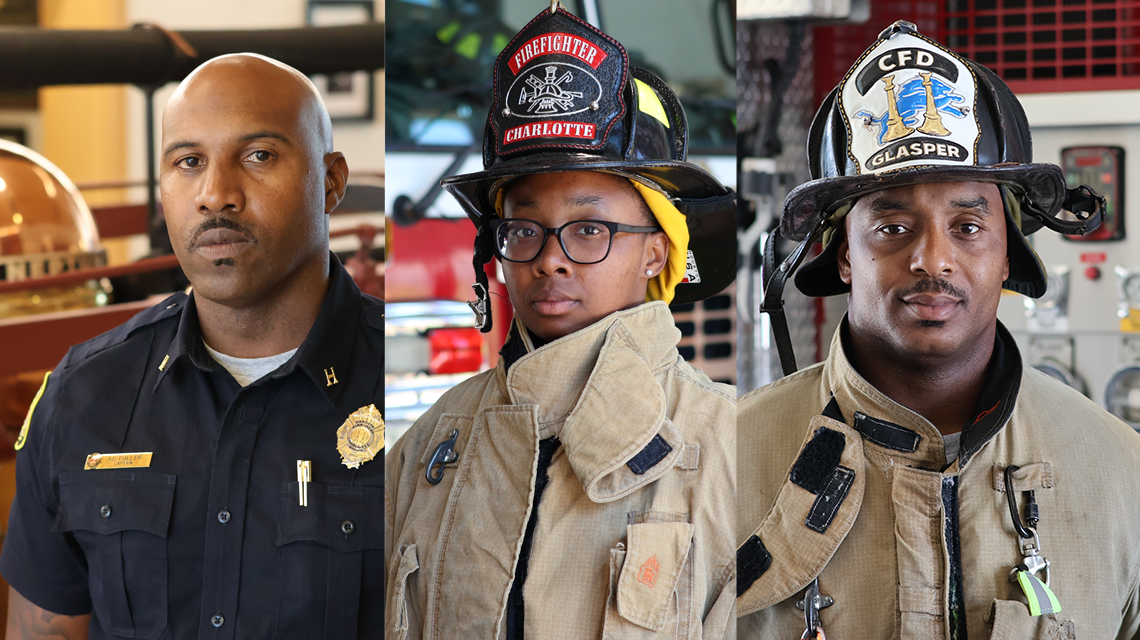
Capt. Andre Fuller, Firefighter LaTia Sneed and Capt. Tyre Glasper reflect on Juneteenth, family history and the meaning carried in the Charlotte Fire uniform.
By Kevin Campbell, Charlotte Fire
For Capt. Andre Fuller, Juneteenth is not simply a date on the calendar.
It is family history. It is a church in Florida. It is a creek where relatives were baptized. It is the memory of standing near the Welaunee Plantation in Jefferson County, Florida, where generations before him lived and worked.
And now, in Charlotte, it is also tied to the uniform he wears.
“Juneteenth is the only holiday that really matters to me pertaining to the United States,” Fuller said. “It is the day that the United States fulfilled the promise that it has had since its inception, when everyone is free.”
Capt. Andre Fuller said Juneteenth has long been personal to his family, shaped by stories passed down through generations and a lifelong commitment to service.
For Fuller, a training captain at the Charlotte Fire Training Academy, that meaning was passed down long before Juneteenth became a federal holiday. It came through family, elders and the stories they made sure younger generations heard.
Fuller said his family often returned to Monticello, Florida, for reunions that connected directly to Juneteenth. They gathered near the church his great-great-grandparents attended and passed places tied to the lives of relatives who came before him.
“My grandmother’s mother grew up on a plantation,” Fuller said. “Every year, we would go back to that plantation for family reunion, to remember the family members that were there. That always coincided with Juneteenth.”
He paused when talking about those roots. The history was not abstract. It was personal.
That is part of what makes Juneteenth different for many Black firefighters serving today. It is not only a celebration of freedom. It is a reminder of the people who carried families forward, the doors they helped open and the responsibility of wearing a uniform in a profession built on service.
For Fuller, the uniform is part of a larger family tradition.
“Everyone in my family pretty much, some way or form, has worn a uniform,” Fuller said. “Whether it’s military, corrections, fire department, sanitation, teaching. It’s all the same. We all come in with a public servant type of history.”
That sense of service connects Juneteenth to the fire service in a way that is not loud or forced. Both are rooted in people. Both rely on legacy. Both ask one generation to carry something forward for the next.
Fire Chief Reginald Johnson said that connection is important to recognize across Charlotte Fire.
“Juneteenth gives us an opportunity to reflect on freedom, service and the people who helped shape the communities we serve today,” Johnson said. “At Charlotte Fire, our strength comes from the men and women who bring their full history, their full experience and their full commitment to this work. When our firefighters serve this city, they carry more than a badge. They carry the stories, values and sacrifices of those who came before them.”
For recently promoted Capt. Tyre Glasper, Juneteenth is a day of celebration and pride. His grandparents were from the South, and he grew up hearing stories about civil rights, freedom and the people who fought for opportunities he now has.
“It was always brought up in my household, mostly by my grandparents,” Glasper said. “Just having pride, knowing the legacy that was set before me, things that were done before me for my liberties going forward.”
Capt. Tyre Glasper said Juneteenth reminds him of the pride passed down by his grandparents and the responsibility of leading by example.
Glasper, a relief captain, said those stories helped shape how he sees himself, his work and the example he sets for his own children.
“I want them to be proud,” Glasper said. “Have a sense of pride. Walk with it. Don’t be ashamed of it. Be proud of who you are.”
That pride follows him into the firehouse.
Glasper said he grew up watching an uncle who was a firefighter in Detroit. After playing football as long as he could, he still felt pulled toward something bigger. Charlotte became home for his family, and the fire service became the career that allowed him to serve.
Now, as a captain, he understands what it means when children see him in uniform.
“Seeing is believing,” Glasper said. “We see it every day here on the fire department.”
He remembers being assigned to Engine 27 on A shift, where he said the crew was one of the few all-Black crews in the city. People noticed.
“We’d go out and people would tell us, ‘Man, I’m not used to seeing four Black people as firefighters,’” Glasper said. “Representation definitely matters. That’s something I truly believe in.”
Glasper said representation in the fire service matters because young people need to see that the career is possible.
For Glasper, representation is not about separating people. It is about possibility.
He said a young person may dream of becoming a doctor, lawyer, firefighter or even president. Seeing someone who looks like them doing that work can make the dream feel real.
“If that person can do it, then why can’t I do it?” Glasper said. “Seeing that as a young Black person, young Black male, young Black female, is huge because you see that it is obtainable.”
That message is especially important in a profession where Black firefighters have not always been widely represented. Glasper said he had no fire experience when he started.
“I stepped out on faith,” he said. “I’m a true testament of what’s possible.”
At Firehouse 33, Firefighter LaTia Sneed carries a similar message, but her path into the fire service started in a different place.
Sneed has a bachelor’s degree in acting and film. After having her son, she wanted a career that offered stability and allowed her to spend time with him. She enrolled in an EMT class, where a fire captain told her she would make a good firefighter.
“At first I was like, ‘Oh no, not firefighting,’” Sneed said. “But then I got bit by the fire bug.”
Firefighter LaTia Sneed joined Charlotte Fire in 2024 after beginning her fire service career in Tennessee, where she became her department’s first Black female firefighter.
She started in Columbia, Tennessee, in 2017, becoming the first Black female firefighter in that department and only the second woman to serve there.
“It was really groundbreaking,” Sneed said.
She joined Charlotte Fire in 2024 as part of Recruit Class 131 and is now assigned to Ladder 33 at Firehouse 33.
For Sneed, Juneteenth brings her back to her grandmother, Eleanor Brewer, who is 98. Sneed said her grandmother made sure the family understood the importance of heritage, freedom, mercy and grace.
“She always wanted us to understand where we come from,” Sneed said. “Freedom, mercy and grace are a blessing to us, and we shouldn’t take them for granted.”
Sneed said Juneteenth gatherings were part of her family’s tradition. Relatives came together, celebrated and remembered what earlier generations endured.
Her grandmother lived through segregation, and Sneed said that makes the celebration carry a deeper meaning.
“For her, I think it meant so much more for us to be able to get together and do the things that she wasn’t able to do when she was younger,” Sneed said.
Sneed said sharing Juneteenth traditions with her children helps keep family history alive for the next generation.
Now Sneed shares that history with her own children.
“I feel like a lot of times history dies with the people that don’t share it,” Sneed said. “You have to share it to continue it.”
That idea, passing history forward, is also part of how Sneed views representation in the fire service.
When she became a firefighter, she did not know anyone who looked like her doing the job. After she joined, she began seeing the effect it had on young girls in Columbia.
“There were so many little girls in Columbia that wanted to be a firefighter because they saw me,” Sneed said. “You really can change your future if they see people that look like them.”
Sneed said representation must be treated with respect, not resentment.
“We don’t have to be negative,” she said. “It’s just something that you see and you’re like, ‘Oh my goodness, they can do it. I can do it.’”
When asked what it means to wear the uniform, Sneed grew emotional.
“It brings tears to my eyes,” she said. “When you put as much sweat and tears and ambition into this, and you get the reward of it, it means the world.”
She thought about her grandmother telling her she is proud.
“It hits different,” Sneed said. “When I was in recruit school, I would give 100% because I knew that the outcome was bigger than the pain I was going through in the moment.”
That outcome reaches beyond one firefighter, one recruit class or one firehouse. It reaches the child watching a ladder truck roll by. It reaches the recruit trying to find their place. It reaches the family member who remembers a time when opportunities looked different.
Fuller said wearing the uniform is part of a family tradition of service, one he now carries into the Charlotte Fire Training Academy.
For Fuller, that is why the lessons of Juneteenth and the work of the fire service can meet in the same place.
He said history should not be something his child is afraid to learn. It should be something that helps him understand what is possible.
“When people had less, they still were able to advance and bring positive change to this country,” Fuller said.
As a training captain, Fuller now helps prepare new firefighters for the streets of Charlotte. His lessons are not only about hose lines, ladders and tactics. They are also about impact.
“I want them to understand the impact of giving back,” Fuller said. “Someone gave to me. I’m giving to them. And I want them to be able to give to others.”
That is the thread running through each story.
A grandmother in Tennessee. Grandparents from the South. A family reunion in Florida. A young girl seeing a firefighter who looks like her. A young man seeing a Black captain and realizing the fire service is possible. A recruit learning that service is something passed from one person to the next.
Juneteenth marks freedom delayed, but finally delivered. For these Charlotte firefighters, it also marks the responsibility to remember, to serve and to be visible for those still deciding what their own future can be.
In the fire service, the uniform carries a badge, a name and a rank.
For Fuller, Glasper and Sneed, it also carries history.