Faith, Family and Fire Shape Bobby Cash’s Charlotte Fire Journey
Published on June 05, 2026
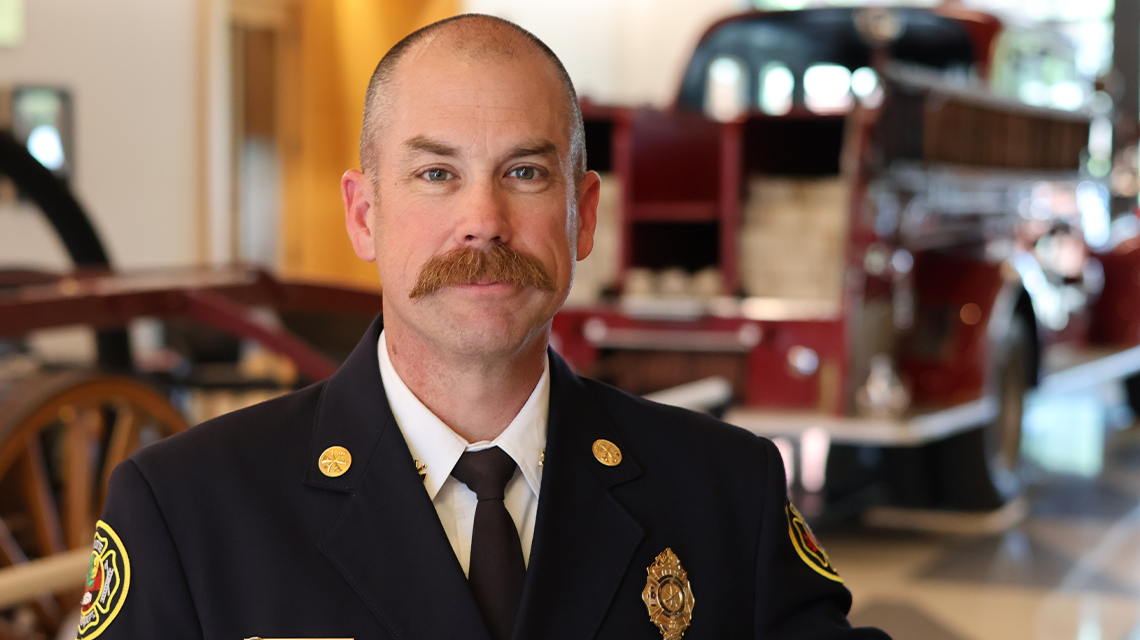
For Bobby Cash, the path to division chief has always been grounded in three priorities: faith, family and service to Charlotte Fire.
When Bobby Cash talks about the fire service, he does not begin with rank.
Cash, who is being promoted from battalion chief to division chief with Charlotte Fire, grew up around the fire service long before he ever wore the uniform himself. Born in Rocky Mount, North Carolina, he moved to Cherryville as a child after his father, a truck driver for Carolina Freight, chose to keep the family closer to home rather than relocate to Atlanta.
Command Staff Bobby Cash stands with Charlotte Fire command staff following his promotion to division chief.
Cherryville became the place where Cash grew up, found his footing and first saw the fire service not as a career, but as a way of life. His half brother served as fire chief in
Cherryville for more than 25 years. Another half brother worked as a full-time firefighter, driver and later captain. Nephews, cousins and other relatives were involved in the fire service as well.
By the time Cash turned 16, it was not hard for those family connections to pull him toward the firehouse. He joined as a volunteer firefighter. At first, he admits, the appeal was simple.
“Initially, it was 100% adrenaline,” Cash said. “I think every 16-year-old and 18-year-old, when they get involved in the fire service, that’s what it is.” But the adrenaline was only the beginning.
The longer Cash stayed around the fire service, the more he saw the deeper meaning behind the work. He saw firefighters make a difference in moments when families were facing some of the worst days of their lives. He saw the value in showing up, not just to put out fires, but to protect what mattered to people.
One memory from Cherryville stayed with him. 
Bobby Cash carries his chief’s hat at Charlotte Fire Headquarters as he prepares for his next role in department leadership.
After a house fire, crews were able to recover jewelry that had been passed down through generations. They returned it to a woman they knew from the community. Her house had been damaged, but something meaningful had been saved.
“That means a lot,” Cash said. “You actually did something. Even though their house is destroyed, you’ve benefited them somehow. We didn’t show up and make it worse. We made it better.”
That idea became part of the foundation of Cash’s career.
At 19, he was hired by the Hickory Fire Department. He spent just over two and a half years there before joining Charlotte Fire in January 2003.
He was 22 years old, married and stepping into a department he had long viewed with respect.
“I had always heard that Charlotte was the best,” Cash said.
From Gaston County, where he lived, Charlotte Fire carried a reputation. Cash knew a few Charlotte firefighters, and he saw the department as a place that operated on a larger scale, with high standards and a strong identity.
He wanted to be part of it.
Bobby Cash stands outside Charlotte Fire Headquarters, where he is being promoted from battalion chief to division chief.
When he walked through the door, he was nervous. He had left a full-time firefighter position to come to Charlotte, but he said he quickly realized he was where he needed to be.
He went through recruit school with then-Captain Paula McDaniel as his training officer and was later assigned to Engine 1. His first captain was Marc Cox, a leader Cash remembers as part of an outstanding crew that helped shape his early years with the department.
Over time, Cash rose through the ranks. But when he talks about his career, he does not frame the journey around personal achievement.
He frames it around faith, opportunity and the people who surrounded him.
“I think God has opened up numerous doors for me in this job, and it’s no part of my own,” Cash said. “It’s Him. I’ve been lucky enough to surround myself with some phenomenal people and learned from everybody I’ve been in contact with.”
That perspective remains central to how Cash sees leadership.
Bobby Cash’s fire service career began as a volunteer firefighter in Cherryville before he joined Charlotte Fire.
As he prepares to step into the role of division chief, Cash understands the position creates more distance from the daily life of a firehouse. As a battalion chief, he still lived in the firehouse environment, interacting with companies and crews every day. As a division chief, the work changes. The responsibilities grow. There are more administrative duties, more difficult conversations and more moments when leadership requires discipline, fairness and patience.
Cash does not minimize that part of the job.
“There’s more discipline involved,” Cash said. “There’s more stuff that’s just not real fun, to be quite honest. It’s not the most fun thing in the world, nobody wants to do it, the giver or the receiver of the discipline, but that’s part of it.”
But Cash said the way leaders handle those moments matters.
He believes people respond better when leaders take time to understand what happened, why it happened and whether there is a problem that needs to be fixed. Rules matter, he said, but so does the way people are treated.
“We’re all humans, right?” Cash said. “We all make mistakes. It doesn’t matter who you are here, we’re all going to make mistakes, and everybody gets a fair shot.”
Cash calls it servant leadership.
Bobby Cash says faith, family and fire have guided his more than two decades with Charlotte Fire.
It is a phrase rooted in his faith and reflected in the way he sees his responsibility to firefighters. He said he and his family are active in their church, and his belief system shapes how he approaches work, leadership and life.
For Cash, the higher the rank, the greater the responsibility to serve.
“My job right now is, I don’t work for Chief Withers at the moment,” Cash said of his current assignment. “I work for the captains in the battalion I’m assigned to. That’s who I work for, is the way I look at things.”
As a division chief, he said that mindset will continue. On paper, he will report through the chain of command, but his daily responsibility will be to support the battalion chiefs on shift and make their jobs easier.
That view of leadership stands out to Charlotte Fire Chief Reginald Johnson.
“Bobby Cash represents the kind of servant leadership Charlotte Fire depends on,” Johnson said. “He is grounded in faith, committed to his family and deeply invested in taking care of firefighters so they can take care of this city. His promotion to division chief reflects not only his experience, but the trust he has earned throughout this department.”
Bobby Cash steps into his new role with a leadership philosophy centered on fairness, accountability and servant leadership.
Cash has already spent time working in the division chief role, including during some of the most challenging periods for staffing during COVID-19. He remembers one stretch when he was filling in and faced 69 hire backs in one day, part of 118 over two shifts.
The experience reinforced what he already knew. Riding as a chief is different from riding a fire truck. The decisions affect more people. The pace changes. The view of the department widens.
But Cash still believes the foundation remains the same.
Do the work. Take care of people. Stay grounded.
That is also the message he hopes younger firefighters learn from him.
Bobby Cash said his leadership style is rooted in serving the firefighters and officers assigned to his shift.
For a firefighter walking into the job, Cash said work ethic matters immediately. Be the last one to sit down. Learn how to make coffee. Take care of the firehouse. Know the job. Know the rig. Know every piece of equipment and how to operate it.
He also believes young firefighters should see chiefs doing the basics.
Cash said he does not like when firefighters are expected to put a chief’s gear on the car for them. Every morning, he wants the newest firefighters to see him putting his own gear on the rig, checking his air pack, looking over the medical equipment, making sure supplies are ready and changing radio batteries.
Those habits matter, he said, because younger firefighters are always watching.
“They see me check my air pack every day,” Cash said. “They see me look at the medical gear on the car.”
Cash said he never expected to reach this point in his career. He sees the opportunity as a blessing, but he also sees it as a responsibility to continue setting the example in small, consistent ways.
The same sense of responsibility appears in his work with the Honor Guard.
For Cash, Honor Guard service is not ceremonial. It is personal. It places firefighters in the middle of grief, often with families who are saying goodbye to someone who gave part of their life to the fire service.
Bobby Cash’s work with the Charlotte Fire Honor Guard has shaped his commitment to service beyond emergency calls.
“Nobody likes going to funerals,” Cash said.
But he believes the responsibility matters because previous generations of firefighters gave so much to the profession. They worked with less equipment, less protection and fewer resources. They ran fires before the job became what it is today.
“They’ve done it all,” Cash said.
When the Honor Guard presents a flag case or recognizes a family after the death of a retired or active member, Cash said many families are overwhelmed. They do not always expect the fire department to remain connected after their loved one is gone.
Cash wants them to know that connection remains.
“They’re still family,” Cash said. “Once you get hired, we’re still all part of each other.”
That word, family, returns often when Cash speaks.
He and his wife, Joy, will celebrate 25 years of marriage in September. They have two children, Cain, 22, and Camryn, 19.
Bobby Cash stands with his family, including his mother Sheila, following his promotion ceremony. The moment reflected not only a professional milestone, but the family support behind his service with Charlotte Fire.
Cash knows the fire service asks a lot from families. Shift work can mean missed time, long days and moments when the job pulls firefighters away from home. But he is clear about the order of his life.
Faith comes first. Family comes second. The fire department comes third.
That does not mean the job is unimportant. Cash said firefighters must give everything they have when they are on duty. The families they serve deserve their full attention, full preparation and full effort.
But he also believes firefighters need to keep their priorities straight.
“The fire department’s not everything,” Cash said.
He wants young firefighters to understand that being committed to the job does not mean losing sight of what matters most outside of it. For Cash, that has always been faith and family.
He hopes his children have seen that.
He hopes they know that even when he was gone for work, they were first. He hopes they remember his work ethic, his faith and the way he tried to treat people the way he would want to be treated.
Bobby Cash says the fire service taught him the value of showing up on someone’s hardest day and making it better.
“If my kid calls right now, and I have the expectations meeting with the command staff at 3 o’clock today, I’m out,” Cash said. “They’ll just have to wait.”
It is a blunt statement, but it captures the way Cash sees his life and career.
The job matters. The rank matters. The responsibility matters.
But for Cash, leadership begins with knowing what comes first.
As he steps into his new role as division chief, Cash carries more than two decades of Charlotte Fire experience with him. He carries the lessons of Cherryville, Hickory and Engine 1. He carries the influence of the captains, chiefs, firefighters and families who shaped him. He carries the weight of a profession that asks its members to enter people’s hardest moments and make them better when they can.
And he carries the priorities that have guided him from the beginning.
In that order.
Bobby Cash is joined by his family, command staff and Charlotte Fire colleagues following his promotion ceremony.