Charlotte Fire Captain Focused on Service and Advocacy
Published on May 26, 2026
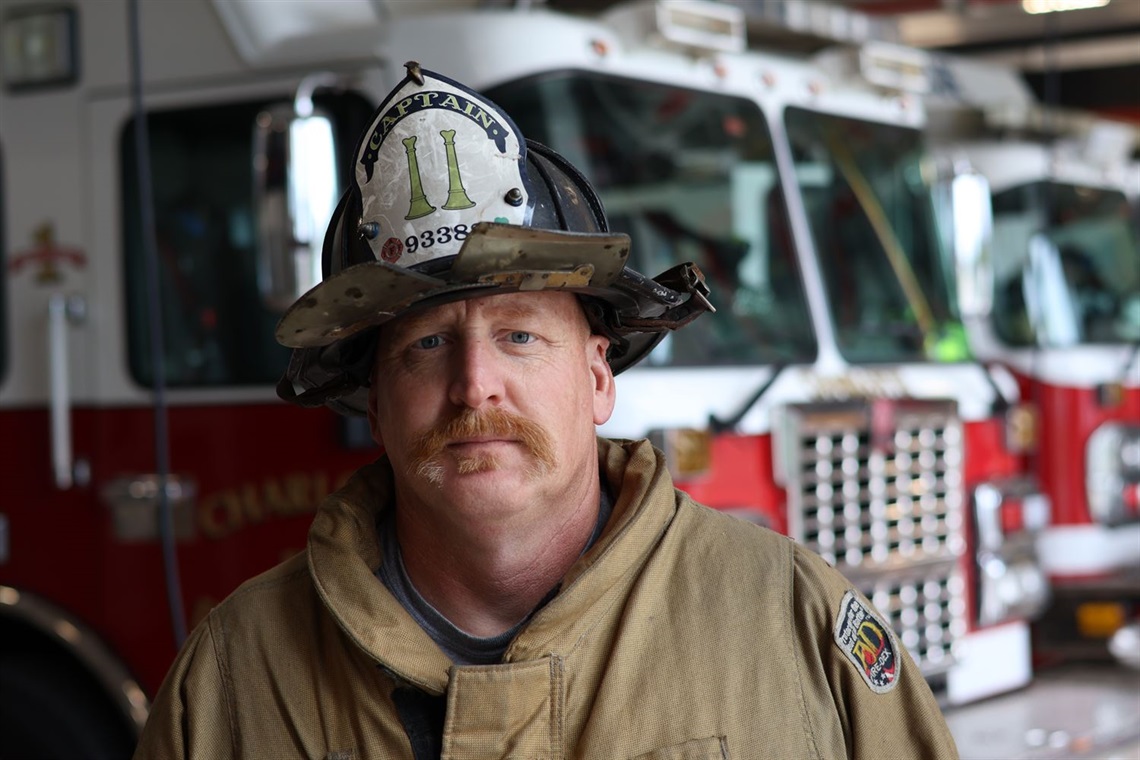
Charlotte Fire Captain Michael Feneis serves both on emergency scenes and as president of the Charlotte Firefighters Association Local 660.
For nearly 25 years, Charlotte Firefighters Association Local 660 President Captain Michael Feneis has carried the responsibility of the fire service both on emergency scenes and beyond them.
He carried it through burning buildings in Detroit during one of the city’s most difficult economic periods. He carried it through deployments with Charlotte Fire’s Special Operations teams during disasters like Hurricane Helene. Today, he carries it into council chambers, meetings and conversations surrounding the future of firefighters in Charlotte.
Feneis never expected that part of the job when he first became a firefighter.
“I was just drawn to it,” he said. “Once I kind of learned about what firefighters do, that’s all I wanted to do.”
Today, the Charlotte Fire captain balances several roles inside the department. He is a company officer, a longtime Special Operations member, a bagpiper with Charlotte Fire Pipes and Drums, a husband and father of three, and the elected president of the Charlotte Firefighters Association Local 660.
Charlotte Fire Captain Michael Feneis was elected president of the Charlotte Firefighters Association Local 660 in 2024.
It is a position that has increasingly placed him at the center of discussions surrounding firefighter pay parity, benefits and long-term investment in Charlotte Fire personnel.
Those who know Feneis describe his leadership style as steady, direct and deeply rooted in the firefighters he represents.
“He cares deeply about the members of Charlotte Fire and about the future of this department,” Charlotte Fire Chief Reginald Johnson said. “Captain Feneis has continued to advocate for firefighters while also maintaining professionalism and respect throughout the process. That balance matters.”
Feneis grew up in Michigan with no family history in the fire service. There was no expectation that he would become a firefighter, but something about the profession immediately connected with him.
“It’s physically demanding,” he said. “I knew I didn’t want to sit in an office.”
He joined the Detroit Fire Department in 2000 and spent more than 13 years there during one of the most difficult stretches in the city’s history.
Feneis works alongside Charlotte firefighters during a medical emergency response.
As Detroit’s economic crisis worsened, public services suffered. Fire companies closed. Staffing levels dropped. Pay and benefits were reduced.
“When I was hired there, we had 1,600 guys,” Feneis said. “When I left, we were down to 900.”
The uncertainty eventually forced difficult conversations at home between Feneis and his wife, Robin. Healthcare reductions and concerns surrounding retirement benefits left them questioning whether Detroit remained the best place to build their future.
“The final straw was they were getting ready to change our pension,” he said. “I just didn’t want to do my 25 years there and retire with nothing.”
The family created a one-year plan. Feneis would apply with departments across the East Coast. If nothing worked out, he planned to return to school and pursue another career.
Charlotte changed that path.
Feneis responds on scene during a structure fire.
After researching several departments, Feneis believed Charlotte offered something Detroit no longer could at the time: stability, growth and opportunity.
He joined Charlotte Fire in 2013 as a member of Recruit Class 92.
At the time, he was already a veteran firefighter in his mid-30s with more than a decade of experience. Starting over in recruit school was not easy.
“Recruit school is hard,” he said. “Not physically or anything like that. Just being off the shift schedule and being away from my family.”
While Feneis attended recruit school in Charlotte, Robin and their children remained in Michigan temporarily to finish the school year. He only saw them every few weeks.
“It was terrible,” he admitted.
Feneis rides with Engine 11 crews while serving as a relief captain across Charlotte Fire.
Still, he understood he had to earn his place all over again.
“I just had to learn how to play the part,” he said. “Keep my mouth shut and my head down and get through it.”
More than a decade later, Feneis believes the move transformed his family’s future.
“I think personally and for my family, it was the best move we made,” he said. “We became a closer, tighter family.”
Charlotte Fire Captain Michael Feneis stands with his wife, Robin, and son, Brogan, following his promotion ceremony.
Today, the Feneis family is deeply rooted in the Carolinas. Their son, Brogan, is 15. Their daughters, Reagan and Kelyn, attend Winthrop University and College of Charleston.
Inside Charlotte Fire, Feneis steadily built his career. He spent six years as an engineer before promoting to captain in November 2025. He currently serves as a relief captain, rotating between firehouses across the city.
Along the way, he became heavily involved in Special Operations.
Feneis holds certifications in confined space rescue, trench rescue, urban search and rescue, dive operations, swift water rescue, high-angle rescue and boat operations. He has deployed on several major incidents, including Hurricane Helene operations in western North Carolina.
The technical demands of Special Operations appealed to the same mindset that originally drew him toward the fire service.
Feneis following his promotion to captain in November 2025.
“You take the best of what you have,” he said when reflecting on his experiences between Detroit and Charlotte.
Outside emergency scenes, another passion developed unexpectedly.
Five years ago, Feneis joined Charlotte Fire Pipes and Drums, becoming part of a group often called upon during memorial services, funerals and ceremonies honoring firefighters and public safety members.
The role carries a different type of responsibility.
Pipes and drums performances often occur during moments of grief and remembrance, requiring members to represent the department with dignity long after the emergency itself has ended.
Feneis performs with Charlotte Fire Pipes and Drums during a public event in Charlotte.
That same sense of responsibility carries into Feneis’ work with the Charlotte Firefighters Association Local 660.
He was elected president nearly two years ago. Since then, the organization has become increasingly active in discussions involving firefighter compensation, healthcare costs and working conditions.
Feneis is careful when discussing the association’s purpose.
“I think sometimes people get skewed on what it really is,” he said. “Our job is safety, pay and benefits.”
Those three categories guide nearly every conversation the association enters.
In recent months, one of the largest discussions has centered on public safety pay parity between Charlotte Fire and the Charlotte-Mecklenburg Police Department.
Under the city manager’s proposed budget, CMPD officers would receive larger raises than Charlotte firefighters. The difference sparked concern among firefighters who believe parity between the two public safety agencies remains important for morale, recruitment and retention.
Feneis wears a Charlotte Firefighters Association Local 660 hat while serving on duty in Charlotte.
Feneis and association leadership have spent months meeting with members of the Charlotte City Council to discuss the issue.
“We’re looking for equity within public safety,” Feneis said. “Police and fire are doing the same job out on the streets, risking their lives every day.”
He stresses the association’s goal is not to diminish the work of police officers or create division among public safety agencies. Instead, he says firefighters want recognition that their responsibilities and sacrifices carry equal value.
“It’s about equity,” he said. “If you increase that gap, it feels like you’re showing one group has more value than the other.”
Feneis believes continued investment in firefighters is critical to maintaining the department’s strength as Charlotte grows and demands on public safety continue increasing.
The association’s work has included regular engagement with elected officials and consistent participation from firefighters themselves.
“Our membership has been awesome,” Feneis said. “Coming to meetings, doing everything we’ve asked during calls to action. It’s been great.”
At the same time, Feneis understands the balance required in his position.
As a captain, he remains part of Charlotte Fire’s leadership structure. As association president, he advocates for firefighters during labor-management discussions. Navigating both responsibilities requires professionalism and trust.
Feneis prepares alongside Charlotte firefighters during an emergency response in Charlotte.
“When I’m talking as a captain, I have obligations through the chain of command,” he said. “When I’m in my union role, I’m representing our members.”
Chief Johnson said maintaining respectful communication remains important throughout the process.
“Healthy communication and respectful dialogue are important in any organization,” Johnson said. “At the end of the day, everyone involved wants Charlotte Fire to continue moving forward and serving this city at the highest level.”
Earlier this year, Feneis attended the Harvard Trade Union Program through the International Association of Fire Fighters, spending six weeks studying labor history, negotiation tactics and leadership alongside labor representatives from across the country.
“It was awesome,” he said. “You learned a good bit about labor history and different teaching aspects for members.”
Even with the growing demands of leadership, Feneis says his priorities remain straightforward.
Feneis returns to the captain’s seat of Engine 11 after helping a Charlotte resident during a medical emergency response.
For Feneis, the mission has never become complicated. Take care of firefighters, advocate for fairness and ensure the people serving the city have the support they need to continue doing the job safely and effectively.
That mindset, he says, extends beyond the fire service and into the example he hopes he leaves for his children.
And when asked what he hopes his son learns from watching him through all of it, his answer comes quickly.
“I hope he learns work ethic,” Feneis said. “And that we always protect the little person.”