‘You Are a Miracle’: Woman Thanks Charlotte Fire For Second Chance
Published on December 06, 2025
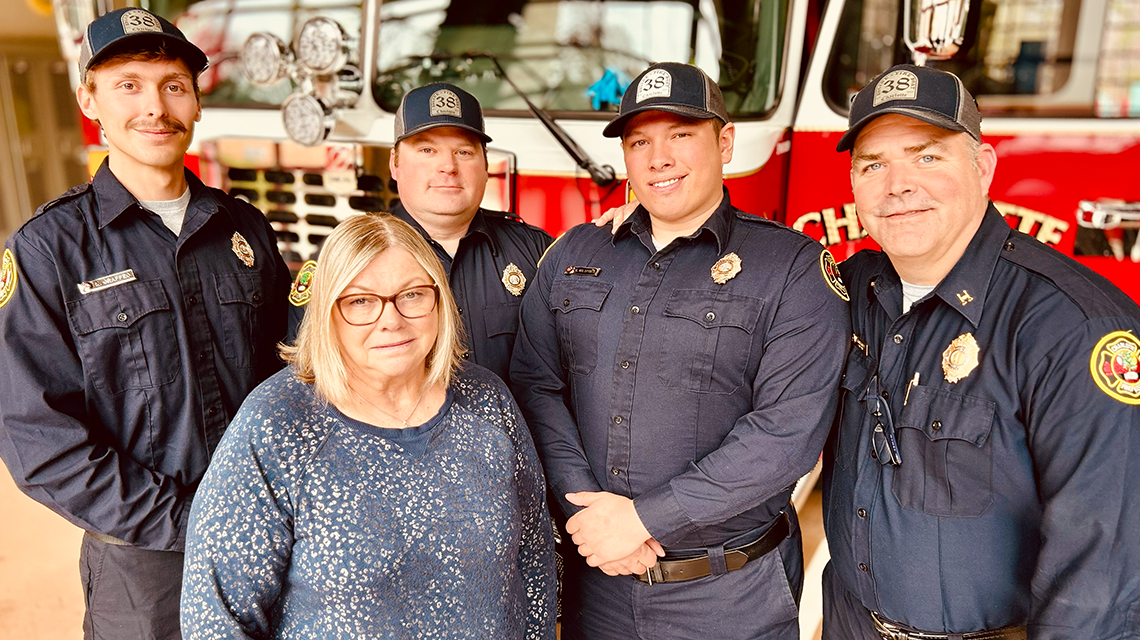
Darlene meets the Engine 38 crew inside the firehouse, sharing stories and gratitude with the responders who were there the night she collapsed.
By Kevin Campbell, Charlotte Fire
The first thing you notice when Darlene Cortez walks into a room is her energy. Her smile arrives before she does, her laugh carries across the space, and the people around her seem to straighten a little, drawn in by someone who knows exactly how precious every hour of life can be.
Inside Firehouse 38, where the call that changed everything began, Darlene stood beside her husband of 42 years, Joey, and looked into the faces of the firefighters who refused to give up on her when her heart stopped beating.
Darlene and her husband, Joey, share a quiet moment outside Engine 38 during their visit with the firefighters who answered the call.
“I just want you to see me,” she told them. “When you are doing this in the future, I want you to feel good about knowing you did not give up. You gave me a second chance.”
A few months earlier, Capt. Jason Merritt and his Engine 38 crew knelt beside her on the floor of a crowded restaurant, working through sweat, noise and chaos to bring her back to life. She had gone into cardiac arrest three times that night, twice in the restaurant and once again in the back of the ambulance. Two Charlotte Fire firefighters performed CPR all the way to the emergency department.
Now she was here, alive, laughing and strong. She wrapped them in hugs. She cried. They cried. And for a moment, a firehouse lunchroom felt like a place where miracles were allowed to walk inside and sit at the table.
Darlene will tell you the story begins earlier that afternoon. At around 3 p.m., she and Joey were leaving Novant Presbyterian after a CT scan. She had been dealing with episodes of atrial fibrillation, and in the weeks leading up to August 12 she had been hospitalized with congestive heart failure and needed cardioversions to stabilize her rhythm. Doctors had recently placed her on a strong heart rhythm medication.
Darlene stands in front of Engine 38, returning to the firehouse with gratitude and a chance to thank the responders who worked to save her life.
Her pulse had been dropping into the 30s at home. She noticed it again that afternoon.
“I was taking my pulse, and it was really low, around 28,” she said. “I stood up and said, I want to jump around. I did not think about calling 911. I thought, I am tough.”
She paced around the room to raise her heart rate, then insisted on driving to meet their friends for dinner. She remembers almost nothing after parking the car.
“Sometimes I will have a flashback of being at the table,” she said. “But truly, I do not remember. And looking back, it is a miracle I did not pass out in the car before I even got there.”
Inside the restaurant, she slid into a booth with Joey and their friends. Behind them sat a retired nurse, a fact that would later become one more part of the timing she believes was not accidental.
Minutes later, Darlene collapsed.
When Engine 38 arrived, patrons led them to where she lay unconscious on the floor. The retired nurse had already begun CPR.
“You were out,” Capt. Merritt told her at the firehouse reunion. “Someone came up and said they had started compressions. We recognized quickly that you had no pulse and no airway. We went right to work.”
Engineer Jonathan Morrison is photographed at Firehouse 38, where he continues to serve the community with the same steady focus he brought to Darlene’s emergency.
Engineer Jonathan Morrison began assisting. Firefighters Kyle Graffeo and Gavin Spires positioned themselves for compressions and ventilations. Merritt attached the defibrillator pads.
“Early compressions and early defibrillation are the priority,” he said. “That is what gives someone a chance.”
What they saw next surprised even a firefighter with 25 years of experience.
“You were throwing up blood,” Merritt said softly. “I had never seen that before. You were throwing clots. It showed us your body was under tremendous strain.”
They delivered the first shock. Her pulse returned.
“And you were scrappy,” Merritt said with a smile. “You started trying to get up. You fought. That is a good sign.”
Captain Jason Merritt stands beside Engine 38, reflecting on the call that brought his crew and Darlene together.
Moments later, she lost her pulse again.
“Each time you went back into cardiac arrest, these guys went straight back onto your chest and kept going,” he said. “No hesitation.”
Medic personnel arrived and continued care in the parking lot. When it was time to transport, Graffeo and Spires climbed into the back of the ambulance and performed nonstop CPR during the ride. Morrison remained with Merritt, escorting the ambulance in Engine 38.
“You will wear yourself out doing compressions,” Merritt said. “So they rotated. One would do about 200 compressions, then the other would take over. They did that the entire way to the hospital.”
Darlene coded a third time inside the ambulance. By the time she reached the emergency department, she had received more than 2,000 chest compressions.
Firefighter Gavin Spires is photographed in front of Engine 38. He was part of the team that delivered care during Darlene’s cardiac arrest.
“It was a hot day,” she said. “A paramedic later told me she kept getting paper towels to mop their faces because they were drenched with sweat. They worked so hard. And they did not give up, not once.”
Darlene spent days in the intensive care unit. She was intubated, sedated and fighting not just cardiac arrest but COVID 19 and severe pneumonia that had gone undetected earlier. She had endured weeks of heart rhythm issues and heavy medication.
Her recovery stunned even her care team.
“When the anesthesiologist walked into the room before my procedure for the ICD, he looked at me, pointed and said, You are a miracle,” she said. “First words out of his mouth. I told him, I know.”
At a follow up appointment, a heart failure specialist reviewed the improvement in her heart function and told her something she had never told another patient.
“She said, This is the first time I have let someone walk out without changing medication, without labs, without scheduling another visit,” Darlene said. “I knew then I was healing.”
Firefighter Kyle Graffeo, one of the first responders on scene that night, stands outside Engine 38 at the firehouse where he serves the community.
She remembers waking up in the ICU hearing the voices of her sister and niece, who rarely travel to Charlotte. She remembers the prayers said at her bedside. She remembers holding on to one sentence in the darkest hours. She repeated it silently over and over. I can do all things through Christ who strengthens me.
“I was not afraid,” she said. “Either Jesus was with me, or I was going to be with him. Either way, I felt peace.”
When Darlene was strong enough to talk, she asked Joey for one thing. She wanted to meet the firefighters.
“Most people do not come back,” she said. “And of the ones who survive, not everyone reaches out. But I was not going to miss the chance to look them in the eye and say thank you.”
She said she wanted them to see the result of their work, to know the hours of sweat on that restaurant floor and in that ambulance meant something.
“You helped me have more time with my family,” she told them. “More time with my grandchildren. How can I not come back to say thank you. You helped give me my life.”
Her gratitude extended beyond survival.
“It was not just that you saved me,” she said. “It was how you treated me, with so much compassion. A lot of people can do the work, but not everyone does it with heart. You all did.”
Around the kitchen table at Firehouse 38, Darlene and her family spend time talking with the firefighters who were there on the night she went into cardiac arrest.
At the table, Merritt listened quietly.
“We see ourselves as instruments,” he told her. “We do what we are trained to do. We care. That is all we know.”
He paused, then added a soft line that made Darlene reach across the table to hug him.
“Jesus saves,” he said. “We rescue.”
The visit to Firehouse 38 continued long after the conversation ended. Merritt and the crew brought Darlene and her family through the bays and showed them the tools they used that night. She saw the defibrillator pads and the airway equipment that had hovered above her while she lay unconscious. She walked slowly, touching the gear that helped sustain her long enough to reach the hospital.
Firefighter Kyle Graffeo looks over the medical equipment similar to what he he used that night, offering Darlene a hands-on explanation of how responders work under intense pressure.
Some of the life-saving tools used in cardiac emergencies sit on the table as the crew walks Darlene through how each piece of equipment supports patient care.
Then they took her outside toward the water and loaded her and her family onto Fireboat 38. The crew opened the nozzles, sending a tall arc of water into the sky. Darlene laughed and covered her mouth, overwhelmed by the moment.
“I want you to know how much you are loved and appreciated,” she told them. “The compassion you have is special. Not everyone can do what you do.”

Darlene steps aboard Fireboat 38 during her visit with the crew who responded to her medical emergency, taking in a closer look at the lake unit’s operations.
Darlene pauses on Fireboat 38 with a steady, thoughtful look, taking in the moment as she reconnects with the firefighters who made such an impact on her life.
Before she left, Merritt made one request.
“Please do not let this be the last time you visit us,” he said. “Come back anytime. We want to see how you are doing.”
She promised she would.
Today, Darlene is busy putting up Christmas trees in her home and catching up on the life she nearly lost. She still has medical steps ahead, but she faces them with a calm certainty that surprises even her doctors.
Every day feels like a gift.
“I know I am a miracle,” she said. “And I am grateful to God, grateful to my family and friends who prayed, and grateful to the firefighters who did not give up on me. They were there at the exact moment I needed them. I will never forget that.”
"Moments like this remind us why we serve. Hearing how Darlene returned to thank the firefighters who fought for her life is powerful. It speaks to the dedication of our crews and the strength of the people we serve," Charlotte Fire Chief Reginald Johnson said.
Darlene walks through Firehouse 38 with her family as firefighters share more about the station and the work they do each day.
Inside Firehouse 38, the crew will not forget either. They see many difficult calls. Not enough endings look like this.
On this day, they stood in their station surrounded by laughter and tears and looked at the woman who fought back, the family who held on to hope and each other.
“You look amazing,” Merritt told her one more time. “It is a miracle. Truly.”