Parkwood Avenue Streetscape: A Street Reimagined
Published on March 17, 2026
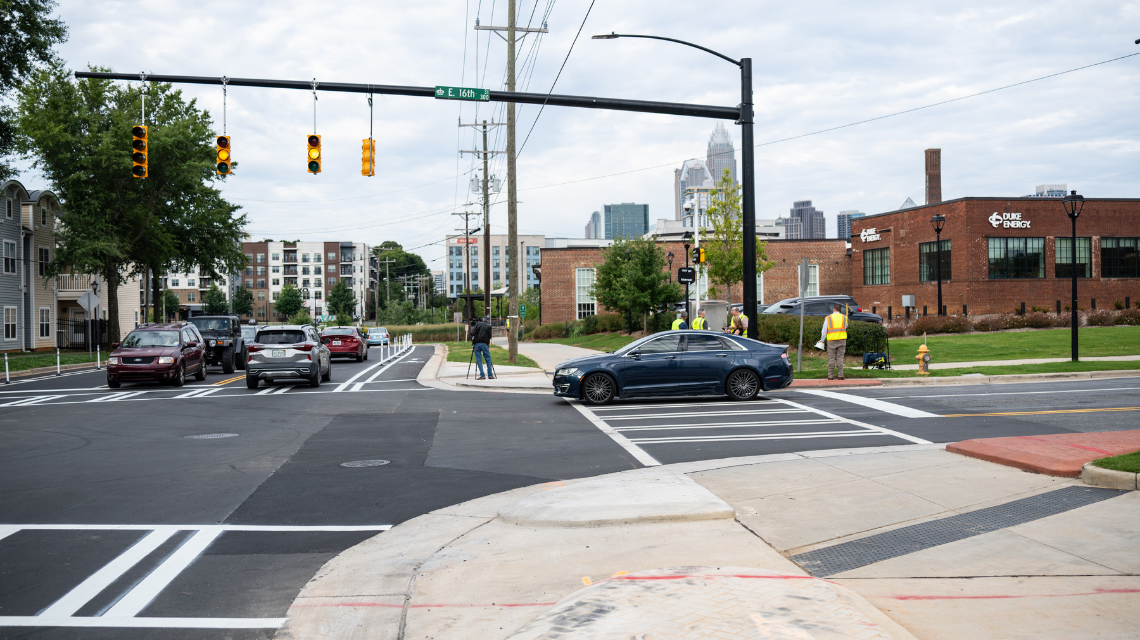
Parkwood Avenue Streetscape.
By Morgan Newell
It’s a Tuesday afternoon on Parkwood Avenue. The sun is out and so are the people eager to enjoy it. The familiar clinking of dog tags fills the air as pets walk down the sidewalk. Chatter from friends heading to an early dinner can be heard from all directions. The soft, recurring thuds of runners’ feet are only drowned out by the occasional buzz of a zipping scooter. It feels natural, like the street was always meant to work this way.
But residents remember when it didn’t.
Before the Parkwood Avenue Streetscape
Parkwood Avenue seemingly grew busier overnight. When the Blue Line Extension was announced, the desire to be on the one-mile stretch of road grew. Townhomes, new apartment buildings and businesses joined the already-existing neighborhoods. However, with more people came more traffic. For Abby Preston, who lives in the area, daily travel used to revolve around a frustrating bottleneck at the intersection of Parkwood Avenue and 16th Street.
“I worked at Camp North End and would try to come home,” she said. “It was almost impossible to turn left onto Parkwood.”
Traffic would stack up as drivers waited for a break in cars, and the nearby railroad crossing only made things worse.
“The train would cause additional issues, and it would get backed up really far,” she said. “It could be frustrating because it was less than two miles between home and work and sometimes I would get stuck on 16th Street for more than 10 minutes.
The intersection of Parkwood Avenue and 16th Street.
Traditional transportation woes weren’t the only problems people experienced. A heightened desire to ditch cars for their own two feet, or even two wheels instead of four, started to develop. However, walking wasn’t much easier. Even though people regularly walked between apartment complexes and nearby businesses, Preston and other residents say the route wasn’t designed for it. “We would walk in the mud sometimes,” Preston said. “Even during construction, people never stopped walking on this road.”
City of Charlotte Construction Inspector Tsakala Nziuki backed this statement with his own account as well. When construction for the project first started, he witnessed many people run across a busy road just to get to the other side of the street. Eventually, these dangerous attempts navigating Parkwood Avenue prompted residents to raise concerns about speeding, safety and limited walking and biking options to City of Charlotte staff and elected officials.
Community Feedback, City Action
In response, the city conducted traffic analyses, organized walking tours and launched extensive public engagement to understand exactly what residents’ pain points were.
After several public input sessions, and coinciding with the Blue Line Extension from Uptown through NoDa to UNCC, construction on a new Parkwood Avenue Streetscape started. Excitement among local residents immediately followed.
“You wouldn’t believe how many people came up to me during construction,” Nziuki said, remembering the early days of the project. “They kept asking, ‘What are you going to do about this intersection? When is that traffic light coming?’ When the materials were on the ground, people were like ‘finally!’”
Construction From the Ground Up
Behind the scenes, building the project required careful coordination and constant communication. As the project’s construction inspector, Nziuki’s job was to oversee day-to-day activity on the site.
“A typical day starts by talking with the contractor’s foreman to see what they’re planning,” he said. “If they’re putting in pipes or doing excavation, you have to make sure underground utilities are marked.”
Striking an unseen water line or cable could halt progress quickly and create headaches for nearby residents, but he worked to keep the project on track.
“It’s disruptive and not productive,” he said. “You lose time fixing mistakes.”
Beyond the technical details, he also became a familiar face in the neighborhood. Nziuki was on the project from “day one.” Residents regularly approached him with questions, concerns or curiosity about what was being built. For him, those interactions were one of the most meaningful parts of the job.
“When I work on something that makes the general public happier, I take pride in that,” he said. “Seeing people’s faces light up, that means a lot.”
Building for How People Actually Move
So, what changed? Instead of a four-lane road, the city converted Parkwood Avenue and The Plaza to a two-lane road with one travel lane in each direction. The other lane was converted to buffered bike lanes and narrowed to create wider sidewalks. Additional traffic signals, including ones specifically for pedestrians, were also installed.
To this day, one of the most noticeable changes is the sidewalk. At a generous 12 feet wide, both Preston and Nziuki said the new path was a game changer for the neighborhood.
“When we were building it, I kept thinking, ‘Man, are we building a road?’” Nziuki said.
“The wide sidewalk makes it possible to have different people like bikers, walkers and scooters,” said Preston. “Everyone gets their own space.”
Added lighting in the area makes it easier to see when it gets dark. Preston said the change made her feel safer walking her dog at night, especially in the winter when the sun goes down early.
Abby Preston and her dog walk down the 12-foot sidewalk.
“The street is well-lit, and it feels like a great, safe place to walk or go for a run,” she said.
The improvements didn’t just change how the street looks though. They changed how people live nearby. Preston said she constantly walks now instead of jumping in her car.
“It’s really nice to be able to go get something to eat without getting in my car,” Preston said. “I have friends who live in the apartments next to Optimist Hall, so I can walk back and forth.”
Preston shared the story of a friend whose circumstances forced him to rethink how he traveled. He totaled his car in a crash. Without the money to get a new one, he decided to buy an electric scooter instead. She explained the Parkwood Avenue Streetscape enabled him to get where he needed to go and still be a part of the community. using a non-traditional mode of transportation.
“That became his main way to get around, and the road updates and light rail connection empowered him to make that decision,” she said. “For people who choose not to drive or don’t have the ability, having so many different options can be life-changing.”
Man rides scooter in the bike lane of Parkwood Avenue Streetscape.
A Streetscape Project to Be Proud of
For Preston, like many other residents living in the area, the transformation is something she’s proud to show off. When her 25-year-old sister came to visit, Preston took her for a walk down Parkwood.
“The beauty of the area really impressed her,” she said. “Her exact words were, ‘Okay, Charlotte!’”
The streetscape project was part of the Northeast Corridor Infrastructure program, a collection of projects intended to improve pedestrian, bicyclist and motorist safety and access to the LYNX Blue Line. The project didn’t just add sidewalks and bike lanes. It reshaped how the corridor works — connecting neighborhoods, businesses and transit while giving people more ways to move. Residents now have an uninterrupted 2.5-mile corridor that links to transit, trails and their own neighborhoods. It improved access to the LYNX stations and the Cross Charlotte Trail.
For some residents, it means easier commutes. For others, it means a safe place to run at night, walk a dog or meet friends for dinner.
“This is definitely one of the best areas in the city now after the project,” Preston said.
In the end, that’s what a streetscape project is really about, which is building a street that reflects how people actually live. This is not the only infrastructure project that has been completed in the city. Find out more about the completed and in-progress projects in the Northeast Corridor Infrastructure program.