Ready for the Days We Hope Never Come
Published on August 26, 2026
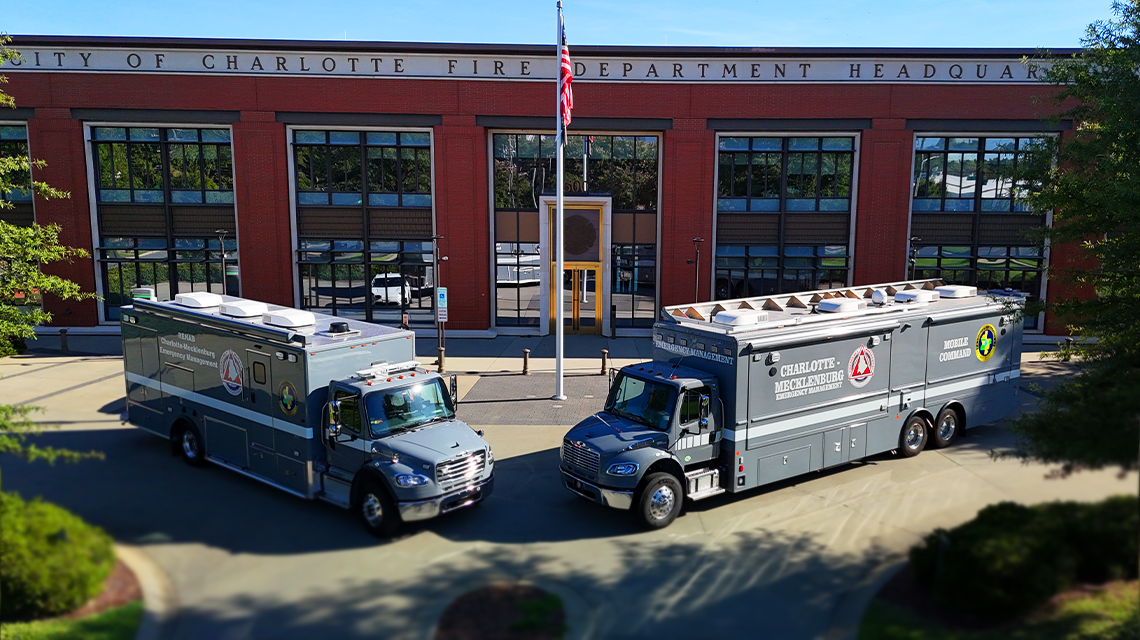
Charlotte-Mecklenburg Emergency Management’s Rehab 1 and Mobile Command Center represent two of the regional resources available to support major incidents, planned events and public safety operations across Charlotte-Mecklenburg and surrounding jurisdictions.
Most emergencies do not respect boundaries.
A hurricane does not stop at a city limit. Floodwater can close roads across multiple jurisdictions. A prolonged power outage can affect neighborhoods, hospitals, businesses and public safety agencies at the same time. A major event can require firefighters, police officers, transportation crews, healthcare systems, utility providers and government leaders to make decisions together, often while circumstances are changing by the minute.
For Division Chief Charles Horne, that is exactly where emergency management begins.
“Where we’re at our best is when we’re breaking down silos between organizations during rapidly changing and evolving events,” Horne said. “We also do a lot of planning for those events, and part of that planning is not only the response, but bringing the right groups together and increasing coordination between those groups.”
During National Emergency Management Awareness Month, Charlotte Fire is highlighting the Charlotte-Mecklenburg Emergency Management Office and the team working every day to prepare for the emergencies the community hopes never happen.
CMEMO coordinates emergency management for Charlotte, Mecklenburg County and the towns of Pineville, Mint Hill, Matthews, Davidson, Cornelius and Huntersville. Its mission covers the entire cycle of an emergency: prevention, preparedness, mitigation, response and recovery.
But Horne says one of the most important parts of that mission is much simpler.
Relationships.
“Relationships are what drive Emergency Management,” he said.
Division Chief and Deputy Director Charles Horne leads the Charlotte-Mecklenburg Emergency Management Office, overseeing planning, preparedness, mitigation, response and recovery efforts across the county.
Those relationships matter because every organization involved in a major emergency has its own responsibilities and its own way of operating.
Charlotte Fire knows how to manage fire and rescue operations. CMPD has its law enforcement mission. Charlotte Department of Transportation has its responsibilities. Hospitals, utilities, county agencies and other organizations all have different expertise and different priorities.
Each can be very good at what it does without automatically being prepared to operate seamlessly beside every other organization.
“The fire department believes that the fire department does a really good job, and they structure the way they respond to things that is best for their mission set,” Horne said. “CMPD, the same thing. Charlotte Department of Transportation, the same thing.”
The challenge comes when all of those mission sets collide during the same emergency.
“The way those individuals operate to mitigate their particular piece of the pie may not easily blend with another organization or another group,” Horne said. “By having those relationships and bringing them together beforehand in coordination planning meetings, you allow them to start talking the same talk, which improves communication.”
That work happens throughout the year, often far from an emergency scene.
CMEMO plans for severe weather, flooding, infrastructure disruptions, hazardous materials incidents, radiological emergencies, acts of violence, major public events and other situations that could require a coordinated response across multiple agencies.
Horne oversees those efforts as CMEMO’s division chief and deputy director. He joined Charlotte Fire in 2000 and has worked in operations, strategic planning, health and safety, special operations and emergency management. He has also deployed across North Carolina during major disasters, including Hurricanes Isabel, Charley, Frances, Matthew, Florence and Helene.
His experience has shown him that the response seen by the public is only one piece of emergency management. Often, some of the most important work took place before anyone knew there would be an emergency.
The Emergency Operations Center becomes one of the clearest examples when a major incident does happen.
Horne calls the EOC “the heartbeat of a long-term, multi-operational response.”
When fully activated, the center can support approximately 75 positions and bring representatives from across city and county government into one operation. Fire, law enforcement, transportation, health and human services, communications, intelligence and other disciplines can all have representation. The county’s fire service is represented as a whole, not simply Charlotte Fire, and private or community partners can also be included depending on the emergency.
Representatives from multiple agencies work inside the Emergency Operations Center during the Hurricane Ian activation. When opened for a major incident, the EOC brings city, county and partner agencies together to share information, coordinate resources and support operations across the county.
The EOC does not replace the incident commander working at the scene.
Instead, it supports that commander and other agencies when the needs of an incident begin to exceed what is immediately available.
Horne uses flooding as a simple example.
Firefighters and police officers may identify multiple roads that need to be closed because of rising water. They can recognize the hazard, but they may not have hundreds of barricades sitting nearby.
“So working with Department of Transportation, we can get some of those barricades out and we can get them deployed,” Horne said.
One agency identifies the need. Another has the resource. Emergency Management helps connect them.
During COVID-19, that coordination became much larger and lasted far longer.
“When the hospitals believed that there were going to be shortages that exceeded their capability, those requests come to the EOC,” Horne said. “It’s the gathering point for the county, and then if we cannot fill those requests within the county, it’s the connection to the state.”
If necessary, those requests can continue into the federal system.
That ability to reach beyond one department, one city or even one county is an essential part of the emergency management structure.
The same philosophy shapes the team Horne leads.
CMEMO is made up of specialists whose work can look very different from one day to the next.
Corbin Hyland leads the Critical Infrastructure and Homeland Security branch, coordinating efforts to protect critical systems and facilities while working with local, state and federal partners.
His responsibilities also include the Urban Area Security Initiative, commonly known as UASI.
The federal program was created after the Sept. 11, 2001, terrorist attacks to strengthen the ability of urban regions to prevent and respond to terrorism and other significant threats. In Charlotte-Mecklenburg, those resources support agencies well beyond the city.
“The UASI comes through Mecklenburg County and is distributed to multiple partners and emergency managers that surround Mecklenburg County,” Horne said.
Those partners can include law enforcement agencies, fire departments, hazardous materials teams and other public safety organizations throughout the region.
Hyland is also involved with regional intelligence initiatives and efforts connected to a future fusion center, bringing together CMPD, state and federal partners to improve threat assessment and information sharing.
Corbin Hyland, branch manager for Critical Infrastructure and Homeland Security, helps coordinate regional preparedness, infrastructure protection and homeland security initiatives through Charlotte-Mecklenburg Emergency Management.
Another branch of the office focuses heavily on planning.
Daniel Glaser-Reich oversees the development and maintenance of all-hazard plans, including the Emergency Operations Plan, while coordinating planning across jurisdictions and ensuring local efforts align with state and federal requirements.
But a plan cannot simply exist on paper.
It has to be tested.
That is where Training and Exercise and Homeland Security Coordinator Jon Ronda becomes part of the process.
Ronda develops and evaluates tabletop, functional and full-scale exercises that allow responders, agency leaders and government officials to work through emergencies before they happen.
Horne described one annual exercise designed specifically for senior city and county leadership. The scenario places decision-makers into a severe-weather emergency that could include power failures or utilities being lost for several days.
“They get to walk through what types of decisions would need to be made from that group during a significant event,” Horne said.
The exercise is not about teaching an elected official how to command a fire scene. It is about making sure the policy-level decisions that support the response have been considered before leaders are facing them during an actual emergency.
“It comes right back to that Emergency Management effort to break down those silos and increase communication between different organizations,” Horne said. “Both the decision-makers and the responders.”
Daniel Glaser-Reich, branch manager for Planning, works alongside regional partners during an emergency management exercise. Exercises allow agencies to test plans, strengthen communication and identify challenges before a real emergency.
Other exercises tackle challenges most residents may never have considered.
CMEMO works with hospitals, first responders and partner agencies on active-violence scenarios that include family assistance and reunification. During any incident involving large numbers of patients or displaced people, families may desperately be trying to locate loved ones while responders are still managing the emergency.
Coordinating that process can become an operation of its own.
Radiological preparedness brings another unique responsibility.
Ashley Riggins serves as CMEMO’s Radiological Emergency Preparedness Planner, developing plans, exercises and response procedures for nuclear and radiological emergencies.
Horne said Mecklenburg County has an unusual planning environment because two nuclear reactors are located within 25 miles of uptown Charlotte.
“If you’re a REP county, or a radiological emergency preparedness county, then you’re going to do a demonstration for FEMA every two years,” Horne said. “Because we have two, we do one every year.”
The work involves extensive regulatory requirements and coordination among local, state and federal agencies.
Radiological Emergency Preparedness Planner Ashley Riggins, right, works with Daniel Glaser-Reich as part of the team responsible for preparing Charlotte-Mecklenburg for a wide range of emergencies and complex incidents.
Other emergencies may require an entirely different kind of response.
A hurricane, extreme heat event, prolonged power outage or other disaster could force residents from their homes or create needs that last long after the immediate emergency is under control.
JD Densmore, CMEMO’s Mass Care Coordinator, focuses on sheltering, feeding and family reunification. His work includes partnerships with human service agencies and organizations such as the American Red Cross.
Horne said that responsibility can become significant quickly.
“Anytime that the county would have to set up for mass care, that runs through their shop,” he said.
Public communication is another essential piece.
Paige Grande serves as CMEMO’s Public Information Officer and Community Preparedness Coordinator, overseeing public outreach, emergency messaging and systems such as CharMeck Alerts and Wireless Emergency Alerts.
The goal is not simply to tell people what happened after an emergency. It is to provide information early enough that residents can make decisions before conditions become more dangerous.
Kisha Grier coordinates grants that help fund planning, training, equipment and preparedness projects. Lexi Santa Cruz works to ensure the Emergency Operations Center remains operationally ready around the clock.
Paige Grande, left, and Lexi Santa Cruz are part of the team working behind the scenes to keep the public informed and the Emergency Operations Center ready. Grande leads public information and community preparedness efforts, while Santa Cruz focuses on operational readiness.
Behind many of those programs are resources that must be purchased, maintained, tracked and moved.
And then there is Matt Brown.
Horne brought Brown up again during a second interview because he felt his role deserved more explanation.
Brown serves as CMEMO’s Logistics Coordinator, helping move equipment, vehicles and other resources where they are needed.
Horne described him as “the doer” in the office.
“Matt is one of those individuals who helps make everything happen,” Horne said.
Sometimes that involves supporting a planned special event. Other times it can mean getting a very specific piece of equipment to an incident in the middle of the night.
“He is also the guy that at 2 o’clock in the morning, when an incident commander needs a track hoe for a very defined reason, can help make that happen,” Horne said.
Logistics Coordinator Matt Brown helps turn emergency plans into action by coordinating equipment, vehicles and other resources needed for planned events and emergency operations.
That example captures much of what emergency management does.
Find the need. Find the person or organization that can meet it. Make the connection. Get the resource moving.
Two specialized vehicles help bring some of that capability directly into the field.
Rehab 1 was placed in service July 22 and is housed at Firehouse 42. The apparatus replaces Charlotte Fire’s previous rehabilitation vehicle and provides a large air-conditioned space, updated technology and new equipment for firefighters operating during extended incidents.
Firefighters working in heavy protective equipment can face significant physical demands, particularly during hot weather or long operations. Rehab 1 provides a dedicated location where members can cool down, recover and be evaluated before returning to work.
The apparatus can respond when requested or required at single-alarm incidents and is accompanied by a structural company during multiple-alarm responses.
It is also a UASI asset, meaning its capabilities are not limited to Charlotte. The vehicle can be requested to support regional partners when needed.
Rehab 1 provides an air-conditioned space, updated technology and additional equipment to support firefighter health and safety during extended incidents. The apparatus is also a regional UASI asset that may be requested to support partner agencies.
The Mobile Command Center provides another deployable resource.
The vehicle has been in use for about a year and is also a regional UASI asset. It gives Emergency Management and partner agencies another option when an incident or major operation requires expanded command and coordination capabilities in the field.
The Charlotte-Mecklenburg Emergency Management Mobile Command Center provides deployable command and coordination capabilities for major incidents, planned events and regional operations.
The trucks may be among the most visible pieces of CMEMO, but much of the office’s success is harder to see.
It is a police officer knowing who to call at another agency because they met during an exercise months earlier.
It is a hospital request moving quickly through the EOC because the process was established before the crisis.
It is a shelter opening, an alert reaching thousands of phones or a piece of equipment arriving from another jurisdiction because someone already knew where to find it.
And sometimes it is simply getting everyone into the same room.
“When the EOC is open, it is speaking for the entire county,” Horne said. “It’s allowing everyone to have a voice.”
That may be the clearest description of the role Charlotte-Mecklenburg Emergency Management plays.
Emergency Management cannot predict every disaster, and it cannot eliminate every challenge that comes with one.
What it can do is make sure the people who will be needed during those difficult moments have planned together, trained together and know how to reach one another.
The hope is that many of those plans will never be needed.
The responsibility is to be ready anyway.