Nearly 40 Years Later, Ted Haney Still Returns to Charlotte Fire
Published on November 12, 2026
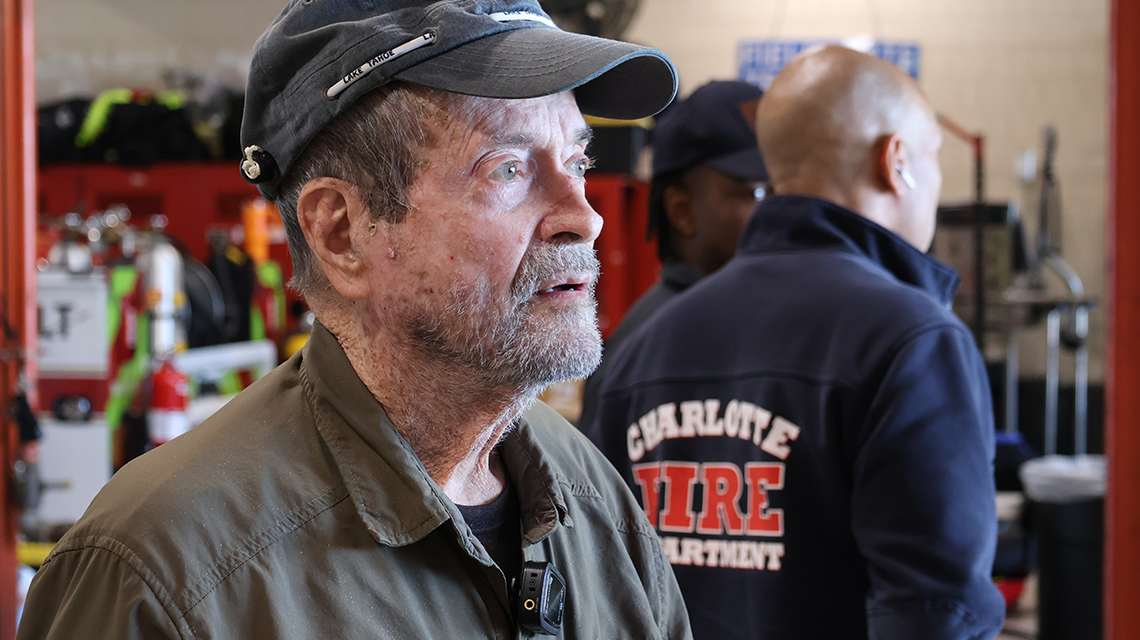
Retired Charlotte firefighter Ted Haney visits Firehouse 17, nearly 40 years after ending his career with the department.
By Kevin Campbell, Charlotte Fire
At 91 years old, retired Charlotte firefighter Ted Haney still carries a reminder of his nearly three decades of service. It isn't tucked away in a drawer or displayed on a shelf. It's right there on his wrist.
The watch was presented to him when he retired on Jan. 1, 1987, after nearly three decades as a Charlotte firefighter. He still wears it today, a small but meaningful connection to a career that began in 1957, when Charlotte looked very different and so did its fire department.
But the watch isn't the only thing connecting Haney to his past.
Every couple of months, Haney makes his way back to Firehouse 17, where he spends time with the firefighters on duty, shares stories and enjoys the company of a new generation serving the city he once protected.
There is no formal occasion or scheduled celebration. According to one of the captains at Firehouse 17, Haney simply stops by to visit, something he has made a habit of doing long after his firefighting days ended.
For the firefighters who welcome him, those visits offer something that cannot be found in a training manual or learned during a recruit academy. They provide a firsthand connection to the department's history through someone who lived it.
Haney regularly returns to Firehouse 17 to share stories and spend time with today's firefighters.
Haney's path into the fire service began long before he ever climbed aboard a fire engine.
Originally from Cabarrus County, near Kannapolis, Haney was drafted into the U.S. Army in 1953. His military service took him to Germany, and he returned to the United States in 1956.
Back in North Carolina, he began looking for work and eventually made his way to Charlotte.
He held several jobs while waiting for an opportunity with the fire department. One involved handling promotional records sent to disc jockeys. He also worked in a shoe store.
Then a relative helped point him toward a different profession.
Haney recalled that a cousin who worked as a police officer told him the Charlotte Fire Department was hiring.
At the time, firefighting seemed like the better choice.
"I just thought it'd be better than being a policeman," Haney said.
It was a decision that would shape the next three decades of his life.
In 1957, Haney joined Charlotte Fire under Chief Donald Charles, who led the department from 1948 to 1963.
Charlotte was a much smaller city then, and its fire protection system reflected that. Haney remembers the department having just nine firehouses when he arrived, with Firehouse 10 opening on Remount Road that same year.
His first assignment was Engine 4 at the old Firehouse 4 in uptown Charlotte.
Built in 1926 on West Fifth Street, the brick firehouse was designed by prominent Charlotte architect C.C. Hook. The building served the department until 1972 and remains a piece of Charlotte's architectural and firefighting history.
For Haney, however, the memories are less about the building's architecture and more about what it took to keep the place operating.
Long before modern firehouses offered many of the conveniences firefighters now take for granted, maintaining the building itself could be part of the daily routine.
Haney remembers the old Firehouse 4 was heated by a coal-burning furnace.
He even recalled hauling coal back to the firehouse to keep the heating system supplied. It was stoker coal, a particular size designed to feed through the furnace's mechanical system.
It is the kind of detail easily lost as the years pass, but one Haney can still describe from personal experience.
And the differences between then and now go far beyond heating a building.
Today's firefighters have equipment, technology and working conditions that would have been difficult to imagine when Haney began his career.
During his recent visit, he pointed out some of those improvements, including individual refrigerators for the department's three shifts, washing machines, additional protective clothing and portable radios.
"Everybody's got a walkie-talkie," Haney said, noting one of the advances he has witnessed.
Modern firefighters also receive two sets of turnout gear, another improvement Haney specifically mentioned.
His assessment of those changes was straightforward.
"It was good for me, but it's much better today than it ever was," Haney said.
There was no suggestion of resentment over how much the profession has improved since his retirement. Instead, Haney seemed pleased that firefighters today have resources that were unavailable during much of his career.
Haney joins Battalion Chief Parks, Capt. Edwards and Capt. Clemonts for a photograph inside Firehouse 17.
When Haney joined Charlotte Fire, Donald Charles was chief. During his career, leadership would pass to Walter J. Black, John E. Lee and R.L. Blackwelder.
Each administration guided the department through different periods of Charlotte's growth.
New firehouses opened, the city expanded, apparatus improved and the responsibilities of firefighters continued to evolve.
Haney was part of that transformation, working through years when firefighting equipment, protective clothing and communication systems were considerably different from those used today.
His career stretched from the late 1950s into the 1980s, a period when Charlotte was growing from a smaller Southern city into a major metropolitan center.
When he finally retired on Jan. 1, 1987, he left with nearly 30 years of experience and something he continues to treasure.
On the back of his retirement watch, the engraving reads:
"Presented to T.W. Haney Char. Fire Dept Benefit Fund 1-1-87"
Nearly four decades later, the inscription remains a permanent record of the day his career came to a close.
The engraving on Haney's watch commemorates his retirement from Charlotte Fire on Jan. 1, 1987.
Retirement may have marked the end of Haney's career, but it did not end his relationship with Charlotte Fire.
His visits to Firehouse 17 are a reminder that the department's history extends beyond old photographs, preserved apparatus and written records.
It also lives in the people who served.
For firefighters accustomed to modern apparatus, protective equipment and communications technology, a conversation with someone who joined in 1957 offers a perspective that few people can provide.
Haney remembers a department with nine firehouses. Today's Charlotte Fire operates dozens of firehouses across a city that has expanded dramatically since his first day on Engine 4.
The people, facilities and equipment have changed, but the importance of passing down experience and maintaining relationships across generations remains.
"Firefighters like Ted Haney helped build the department we are today," Fire Chief Reginald Johnson said. "When our retirees come back to a firehouse, they bring decades of experience, history and perspective that our younger firefighters can learn from. Ted's continued connection to Charlotte Fire is a reminder that our commitment to one another doesn't end when someone retires."
That connection is evident in the simple way Haney spends his time at Firehouse 17.
He doesn't need a ceremony, a formal invitation or an audience.
He comes to spend time with firefighters, talk about the past and enjoy being around a profession that was part of his life for nearly 30 years.
There is something meaningful about a retired firefighter who continues walking through a firehouse door nearly four decades after his last day on the job.
For Haney, those visits offer an opportunity to reconnect with the department he remembers. For the firefighters at Firehouse 17, they offer a chance to hear firsthand what the job was like before today's technology and modern conveniences.
And as Haney makes his way through the firehouse, still wearing the watch presented to him in 1987, the years separating his generation from today's firefighters seem a little less distant.
The equipment has changed. The firehouses have changed. Charlotte itself has changed.
But Haney keeps coming back.
And nearly 40 years after his retirement, there is still a place for him at the firehouse.
Charlotte Fire Captain Edwards assists Haney through a doorway during one of his visits to Firehouse 17.