Charlotte Fire deploys cutting edge hazmat lab for faster response
Published on March 24, 2026
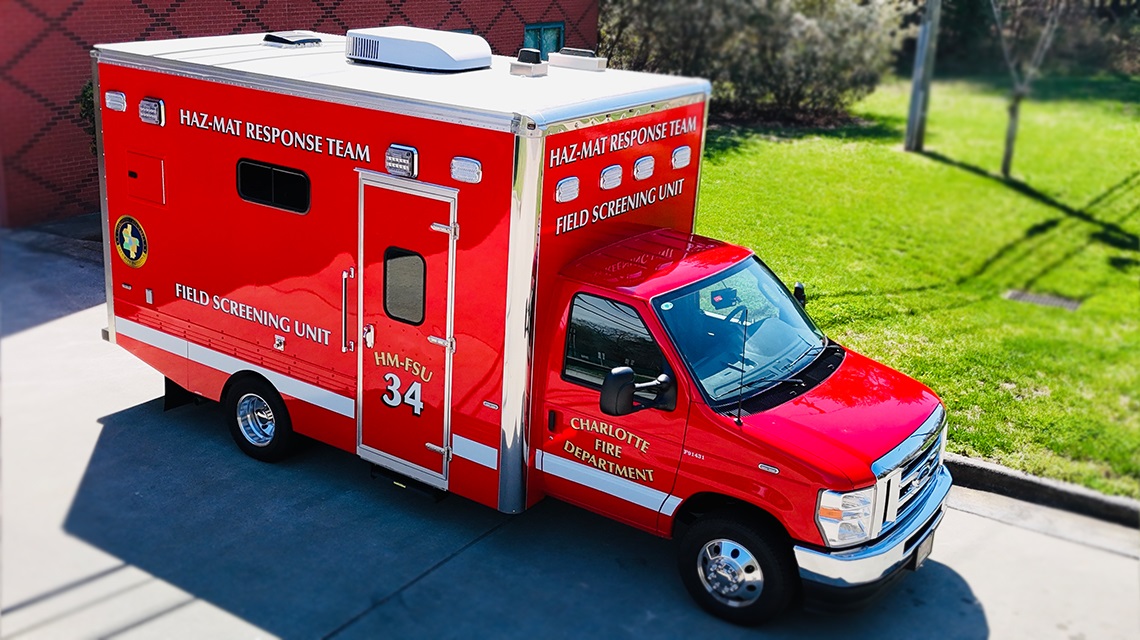
Charlotte Fire’s HM-FS 34, a mobile field screening unit, provides on-scene analysis of hazardous materials to support safer, faster response.
By Kevin Campbell, Charlotte Fire
It doesn’t look all that different at first glance. Bright red. Clean lines. Another specialized vehicle in a fleet built to handle anything.
But inside Charlotte Fire’s HM-FS 34, the difference is immediate.
This is not just a truck. It is a controlled environment. A mobile laboratory. A place where unknown hazards are no longer mysteries left to time and distance, but problems that can be analyzed in real time, with precision and purpose.
The exterior access point of HM-FS 34 allows samples to be placed directly into a controlled environment.
For a department that operates as an all hazards agency, the arrival of a field screening unit like HM-FS 34 represents a meaningful step forward in how Charlotte Fire approaches one of the most unpredictable aspects of the job: hazardous materials.
Division Chief Matthew Honaker, who recently stepped into his role leading Charlotte Fire’s Special Operations Division, oversees one of the most critical components of the department’s emergency response system. Inside the Center for All Hazards Resource and Operations, a 64,000 square foot facility that serves as the backbone of Charlotte Fire’s specialized response, Honaker and his team manage everything from hazardous materials incidents to structural collapse and large-scale disaster deployments.
Division Chief Matthew Honaker, who oversees Charlotte Fire’s Special Operations Division, stands inside the Center for All Hazards Resource and Operations, home to the department’s most specialized equipment and response capabilities.
“This is really about giving our people a safe, controlled place to do their work,” Honaker said. “We’re not guessing anymore. We’re not working out of the back of a truck or in the middle of a parking lot. We’ve created an environment where we can operate the way it’s supposed to be done.”
The idea behind HM-FS 34 did not start with a design. It started with a problem.
Charlotte Firefighter Filliben, a hazmat technician, stands inside HM-FS 34, equipped with protective gear for safe sample analysis.
For years, hazmat crews responding to unknown substances were often forced to make critical decisions without the benefit of a proper workspace. Samples collected from the field had to be handled carefully, but the options were limited. Sometimes that meant working outside in the elements. Other times, it meant using the cab of a truck or a small section of an apparatus not designed for that purpose.
“It just wasn’t optimal,” Honaker said. “We didn’t have a place that was clean, secure and built for what we were trying to do.”
That gap became more evident as incidents grew more complex. Suspicious powders, unknown liquids, potential chemical exposures and situations involving possible criminal intent all require a level of control that traditional operations could not always provide.
Charlotte Fire’s HM-FS 34, a field screening unit, provides a mobile laboratory for hazardous materials analysis.
The result is HM-FS 34, a field screening unit designed to bring that controlled environment directly to the scene.
Inside the truck is a certified vent hood system similar to what would be found in a laboratory. It allows responders to place a sample into a sealed environment without contaminating themselves or the rest of the vehicle. A responder can place the sample through an exterior access point, seal the system and allow personnel inside the unit to begin analysis in a controlled setting.
If the material is hazardous, the system is designed to contain it. Filters can be replaced and the unit can be safely returned to service without exposing personnel.
Inside HM-FS 34, a fully equipped workspace allows Charlotte Fire crews to safely analyze hazardous materials on scene.
“It’s built so that contamination stays where it’s supposed to stay,” Honaker said. “That’s the biggest piece. We’re protecting our people while still getting the answers we need.”
The truck is equipped with climate control, onboard water, decontamination capability and independent power. It is designed to operate in extreme conditions and in areas where traditional infrastructure may not be available. It can function as a self-contained workspace whether in the middle of the city or deep in a rural area.
One of the most notable tools inside HM-FS 34 is the MX908 handheld mass spectrometer, a device capable of identifying chemical substances at extremely small concentrations. Charlotte Fire is one of only two departments equipped with this level of capability.
A Charlotte Fire hazmat technician operates the enclosed hood system inside HM-FS 34, designed for safe, controlled testing.
The device can detect solids, liquids, vapors and aerosols down to parts per billion and compares findings against a built-in library of known substances. It allows crews to begin identifying what they are dealing with within minutes.
Battalion Chief Gary Hensley, who recently assumed leadership of Charlotte Fire’s hazardous materials program and serves as the lead for Regional Response Team 7, said that capability changes how crews approach incidents.
Battalion Chief Gary Hensley, who leads Charlotte Fire’s hazardous materials program and Regional Response Team 7, stands inside the Center for All Hazards Resource and Operations, where specialized resources support complex incident response across the region.
“It’s another tool in the toolbox,” Hensley said. “We’re not saying it’s 100 percent definitive because final confirmation always comes from a lab. But if we can narrow something down to a high level of confidence, that changes everything about how we operate.”
Before this capability existed in a mobile environment, samples often had to be packaged and sent off for analysis, leaving responders waiting for results.
A hazmat technician prepares the MX908 device inside HM-FS 34, supporting on-scene chemical identification.
“That time matters,” Hensley said. “It helps us make better, more informed decisions right there on scene.”
Beyond the technology itself, the value of HM-FS 34 is in what it allows crews to do in the moment. Hazardous materials incidents are often defined by uncertainty. Responders are making decisions based on limited information, balancing speed with safety while trying to protect both the public and themselves.
With the ability to analyze materials on scene, that uncertainty begins to narrow.
Instead of relying solely on visual indicators or waiting on outside confirmation, crews can begin building a clearer picture of the hazard almost immediately. That information shapes everything from evacuation decisions to protective measures and resource deployment.
A technician receives equipment through the sealed hood system, minimizing contamination risk during testing.
“It gives us a better understanding of what we’re dealing with,” Hensley said. “And when you understand the problem better, you can make better decisions.”
That shift is not just operational. It is personal.
For the firefighters and hazmat technicians doing the work, having a controlled environment means fewer unknowns and fewer unnecessary risks. It reduces the chance of exposure and creates a more deliberate, methodical approach to incidents that can otherwise feel unpredictable.
The MX908 handheld mass spectrometer allows Charlotte Fire to detect hazardous substances in real time.
It also allows Charlotte Fire to operate with a level of efficiency that was not previously possible. Instead of stopping progress while waiting for outside analysis, crews can continue moving forward, adjusting tactics in real time as new information becomes available.
In many cases, that can mean resolving an incident faster while maintaining a higher level of safety.
The presence of HM-FS 34 also reflects a broader shift in how Charlotte Fire approaches complex incidents. As the city continues to grow and evolve, so do the types of emergencies the department is called to handle. Industrial sites, transportation corridors and large scale events all bring new variables into play.
 A hazmat technician prepares a sample for testing inside HM-FS 34’s enclosed system.
Having a resource like this positions Charlotte Fire to meet those challenges head on.
“This is part of staying ahead of the problem,” Honaker said. “We know the environment we operate in is changing, and we want to make sure we’re ready for that.”
While HM-FS 34 serves Charlotte and Mecklenburg County, its reach extends well beyond the city.
 A hazmat technician collects a sample for analysis using the MX908 system inside HM-FS 34.
As part of Regional Response Team 7, Charlotte Fire provides hazardous materials support to 11 surrounding counties and can deploy across North Carolina through Emergency Management when needed. The unit can be requested as part of a larger coordinated response when incidents exceed local capabilities.
In that sense, the truck functions as more than a local resource. It is part of a broader system designed to support communities across the state.
“If it’s needed, there’s a process to get it where it needs to go,” Hensley said. “At the end of the day, we’re all working toward the same goal. It’s about helping wherever we’re called.”
The MX908 displays a simulated detection result, highlighting its ability to identify potential explosive materials.
The unit has already proven valuable in multi agency environments, supporting law enforcement partners including CMPD, the FBI and the State Bureau of Investigation during training exercises and coordinated operations. Its design allows agencies to maintain chain of custody, document evidence and conduct analysis in a controlled setting.
“It opens the door for a lot of collaboration,” Honaker said. “We’re able to support not just fire operations, but the broader response.”
The truck is housed at Firehouse 34, which also serves as the base for North Carolina Task Force 3. That team has deployed to major incidents including Hurricane Helene and flooding in Kentucky, providing rescue and support operations during large scale disasters.
Within that system, HM-FS 34 represents another layer of capability.
“This is about continuing to move the program forward,” Honaker said. “We inherited a strong foundation. The goal is to build on it and make sure we’re giving our people what they need to do the job at the highest level.”
Charlotte Fire Chief Reginald Johnson said investments like this reflect the department’s commitment to readiness and service.
“Our community expects us to be prepared for anything,” Johnson said. “That means equipping our firefighters with the tools and technology that match the standard we hold them to every day.”
 The front of HM-FS 34 highlights its role as Charlotte Fire’s hazmat response field screening unit.
Most people may never see HM-FS 34 in action. It is not a truck that responds to every call.
But when it is needed, it represents a different kind of response. One built on precision, safety and the ability to understand a hazard before it becomes something worse.
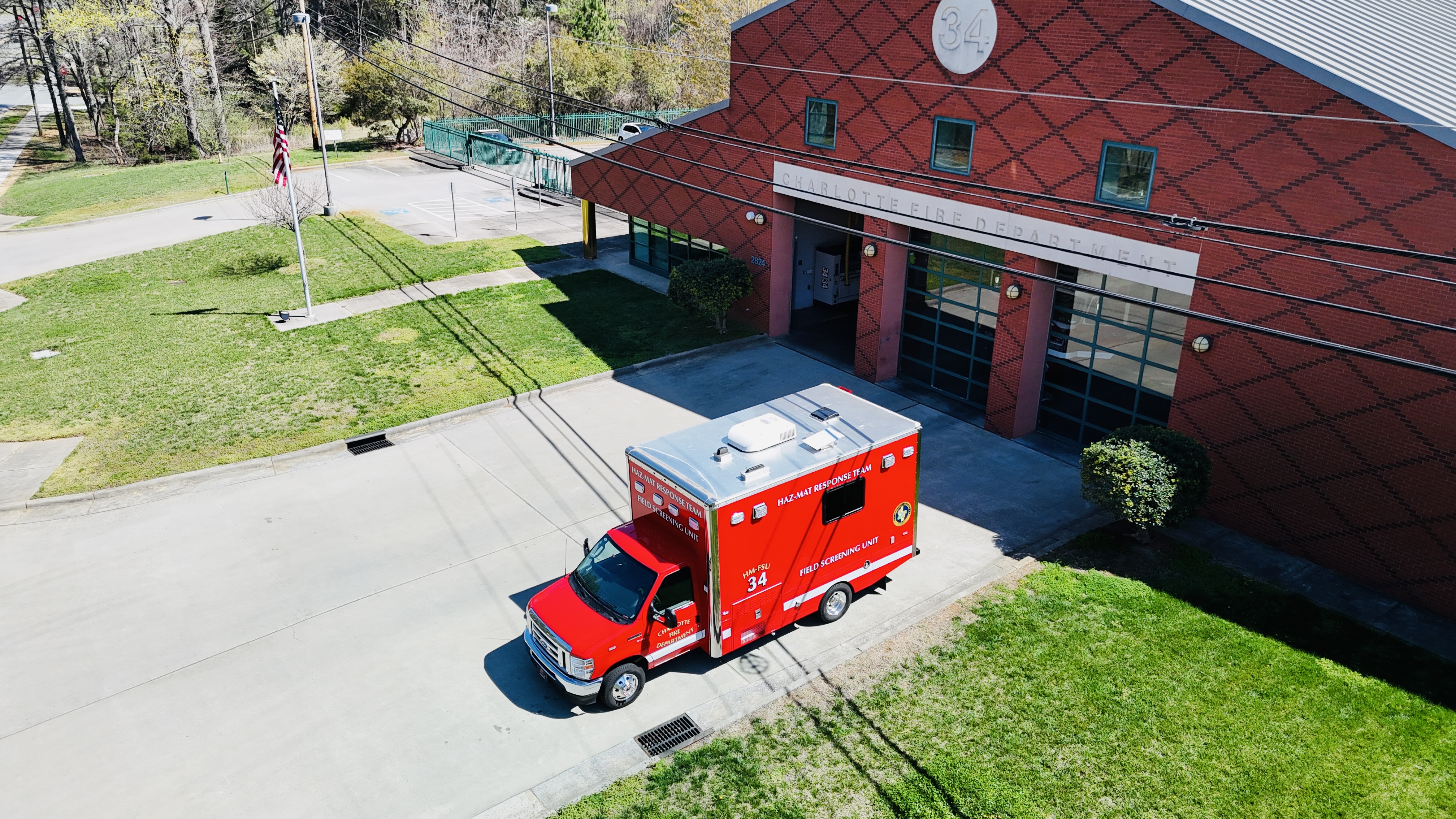 Firehouse 34 HM-FS 34 sits outside Firehouse 34, where the mobile field screening unit is housed and deployed.
“It’s nice to know we have a place to go, no matter what we’re dealing with,” Honaker said. “Hot, cold, rain, whatever it is, we can step inside and do the job the right way.”
In a job defined by uncertainty, HM-FS 34 brings a level of control that did not exist before. It does not change the risks. It changes how Charlotte Fire meets them.
Firefighter applications with Charlotte Fire open May 15. Stay informed on the upcoming process by signing up for updates here. BECOME A CHARLOTTE FIREFIGHTER