A Charlotte Firefighter, a Ballfield and a Lifesaving Run
Published on July 15, 2026
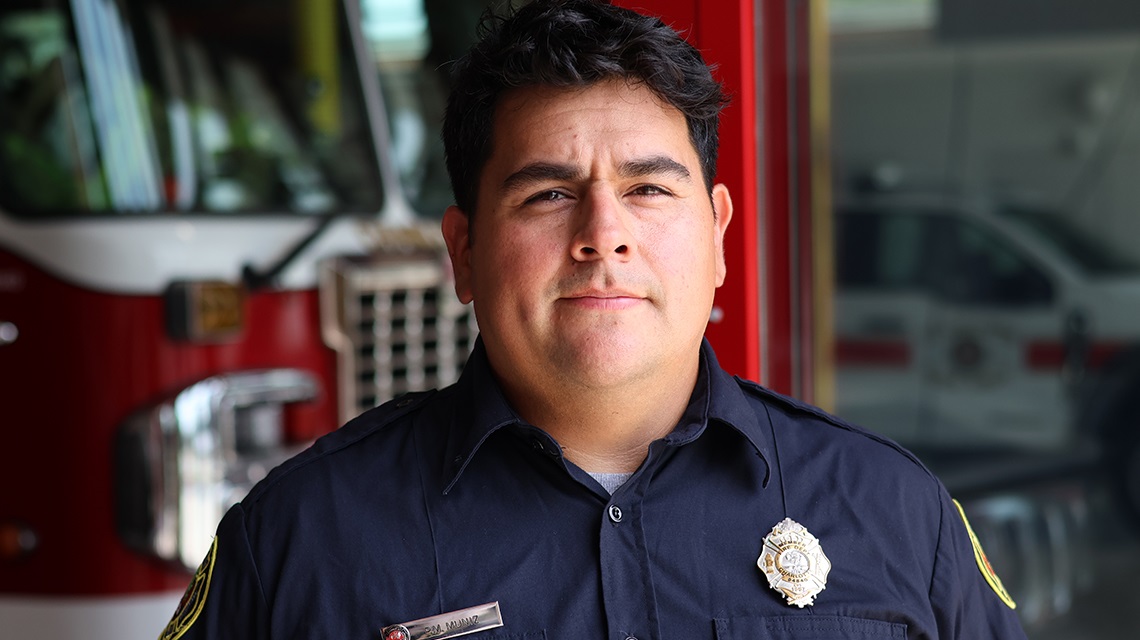
Charlotte Fire Firefighter Pedro Muniz stands at Firehouse 11, where he serves on Rescue 11 as part of Charlotte Fire’s special operations response.
By Kevin Campbell, Charlotte Fire
Charlotte Fire Firefighter Pedro Muniz had already spent most of the day at a baseball tournament in Statesville with his family. It was hot, the kind of day when the natural move after two games would have been to head home, cool off and call it a day.
But Muniz’s kids wanted more baseball.
For Muniz, a father of four and longtime coach at the Steele Creek Athletic Association fields, that was not a hard sell. If his children wanted to get in extra work, he was going to be there with them.
“I’ll never say no,” Muniz said. “If they want to do it, I’m 100%.”
That decision put Muniz at the ball fields on a day when a normal afternoon of youth baseball turned into a fight for a child’s life. It also placed him close enough to hear sirens from Charlotte Fire Engine 37 and Ladder 26, close enough to check the call information on his phone and close enough to see people gathering around a boy on the ground.
Muniz was off duty at the Steele Creek Athletic Association fields when he heard the call for a 13-year-old in cardiac arrest nearby.
The call was for cardiac arrest. The patient was 13 years old.
Muniz looked from Field 4, where he was with his family, toward Field 8, about 150 to 200 yards away. From where he stood, he could see the child down on the field and several adults nearby. He did not know the boy. He did not know exactly what had happened. He only knew what the call information said and what the scene in front of him appeared to show.
For Muniz, there was no pause.
“It was a no-brainer,” he said.
He dropped everything and ran. Muniz knows those fields well, but in the urgency of the moment, he could not immediately find the gate. Rather than search for it, he jumped the fence and kept moving.
“My wife said that’s the fastest she’s ever seen me run,” Muniz said. “I’m pretty sure I blacked out running.”
The boy was Bryson Blanton, a 13-year-old baseball player who had just been playing in his second game of the day. Bryson had made a diving catch in the outfield to end an inning, then came to the plate and hit a double. After sprinting to second base, he collapsed.
By the time Muniz reached him, a coach had started CPR. An off-duty Charlotte-Mecklenburg Police Department officer was also helping, though Muniz said he did not know that at the time. He only knew that a child was on the ground and the people around him were trying to keep him alive.
Muniz said training took over as he checked for a pulse, helped manage Bryson’s airway and worked with others performing CPR.
Muniz identified himself and moved into the work. He told the person doing compressions to continue, then briefly checked for a pulse at Bryson’s neck.
He did not feel one.
“No heartbeat,” Muniz said.
That moment could overwhelm someone without training. For Muniz, the urgency was real, but the response was controlled. Training narrowed his focus to what had to happen next. Keep compressions going. Manage the airway. Check for signs of circulation. Watch the body. Stay ahead of the next step.
There was blood in Bryson’s mouth, and Muniz worked to help clear and manage the airway while CPR continued. He said the compressions being performed when he arrived looked strong, and his message was simple.
“Whatever you do, keep going,” Muniz remembered saying.
Several people assisted before Charlotte Fire crews arrived, rotating through the exhausting work of CPR and helping maintain the effort until more equipment and personnel reached the field. Muniz does not remember every detail of who did what or how many rounds of compressions each person completed. He remembers the work, the urgency and the need to keep moving.
Engine 37 and Ladder 26 arrived quickly. Once Charlotte Fire crews reached Bryson, they moved into the coordinated response Muniz has been part of many times on duty. Pads were placed on Bryson. CPR continued. Muniz remained involved, helping with suction and assisting crews as they worked.
Muniz said the work on the field came down to the next step, the next breath and the next chance to keep Bryson alive.
He believes Bryson was shocked twice before the ambulance arrived. Around that time, Muniz said, there were signs Bryson was trying to breathe on his own.
For Muniz, those minutes on the field were not about recognition or emotion. Not then. In the moment, he said, he was not thinking about his own children or the weight of a 13-year-old boy lying on a baseball field without a heartbeat. He was thinking about the work in front of him.
“The next two or three steps,” Muniz said. “Compressions. Airway. What do I need to do for the heart inside this body?”
The deeper impact came later.
Muniz has four children: Bentley, 13; Petey, 8; Mila, 6; and Maddox, 4. His oldest son is the same age as Bryson. That reality was impossible to ignore once the emergency was over and the adrenaline had faded.
“At the same time, this is somebody’s kid,” Muniz said. “Kids are my thing.”
Muniz said he does not take moments with his own family for granted. He described his family as his oasis, the place where everything feels right after the calls and stress of the job. He also knows that firefighters and first responders often leave emergencies without ever knowing the final outcome. They respond, they work, they transfer care and they move on to the next call.
“Typically, you do something and then you hope for the best,” Muniz said. “We don’t follow up on stuff.”
The call gave Muniz something firefighters do not always receive: a chance to see what happened after the emergency.
This time was different.
Bryson survived. Doctors later found a heart condition that had gone undetected. He spent weeks in the hospital, but he woke up, began talking and started walking. His recovery gave Muniz something firefighters do not always receive: the chance to see what happened after the call.
Bryson’s mother reached out to Muniz and asked whether he would be willing to visit. Because Bryson was 13, because he had survived and because the family wanted that connection, Muniz agreed.
About two weeks after the collapse, Muniz went to the hospital. Bryson had recently been taken off the breathing tube. He was talking and walking, and when Muniz arrived at the hospital room, Bryson was not there. He was in physical therapy.
Muniz and the others went to find him. As the elevator doors opened, Bryson and his father were coming toward them.
Bryson was shy. Muniz remembers him looking down, unsure what to do with the attention from the people who had been there on the field. Muniz tried to make him comfortable. He talked with him and his father, asked what he remembered and mixed in a few jokes to help ease the moment.
Bryson remembered hitting the ball. After that, there was not much.
They talked for about 20 or 30 minutes. They took a photo, which Muniz told the family to keep for themselves. He did not go to the hospital to make the moment public. He went because the family asked and because this call carried a different weight.
“It being a kid, a 13-year-old, it’s like, OK,” Muniz said.
The visit also gave Muniz a chance to tell Bryson something important. Because of what happened, because of what he survived and because of what others might learn from his story, Muniz told him he now had a voice that could help other people.
“You’re an advocate now for your situation,” Muniz said.
Muniz said the timing of that day still stays with him because several people who helped Bryson had not planned to be at the field.
Muniz understands how rare the moment was. He was not supposed to be at the field that day. His family had already been at baseball most of the day. They went back out only because his kids wanted to practice. He later learned the off-duty CMPD officer also may not have expected to be there. The timing, the location and the people nearby all came together in a way Muniz still thinks about.
“This is a blessing in disguise,” he said. “I wasn’t supposed to be there. We didn’t plan to be there.”
Being ready, though, has been part of Muniz’s life for a long time.
Born in San Diego, Muniz moved to Charlotte with his family as a teenager. His father was a preacher, and Muniz grew up hearing stories about his father’s time around wildland firefighting and forestry work in California. From his earliest memories, Muniz said, he knew he wanted to be a firefighter.
He started volunteering with Steele Creek right out of high school in 2008. He took classes, kept learning and kept applying to Charlotte Fire. It took seven attempts before he was hired in 2015 at age 25.
Muniz was hired by Charlotte Fire in 2015 after years of volunteering, training and applying for the job he had wanted since childhood.
Today, Muniz serves as an firefighter on Rescue 11 at Firehouse 11, part of Charlotte Fire’s special operations response. The assignment suits him. Rescue work brings technical calls, specialized tools, rope systems and situations that require crews to solve complex problems under pressure.
“I love having to think outside the box,” Muniz said.
Medical calls are also part of the work. At Firehouse 11, Muniz said, when Engine 11 responds to a CPR call in their area, Rescue 11 goes with them when available. On those calls, Muniz said, he is in the rotation for compressions every time.
“We’re trained to do something,” he said. “We’re trying to make a difference, so why not jump in the action?”
That is one of the lessons Muniz hopes people take from Bryson’s story. Emergencies do not wait for the right setting. They happen at homes, workplaces, ball fields and public spaces where families least expect them. When they do, immediate CPR and quick action can help bridge the gap until firefighters, paramedics and emergency medical personnel arrive.
Whether assigned to Rescue 11 or standing on the sidelines at a baseball field, Muniz said the training is there for one reason: to help when someone needs it most.
On that day, Muniz was not on duty. He was not in uniform. He was not assigned to the call.
He was a dad at baseball practice.
But when he heard the sirens, checked the call and saw a child down across the fields, years of training and instinct took over. Muniz ran toward Bryson because that is what the moment required.
And because he did, a 13-year-old boy’s story did not end on a baseball field.