Shared Mobility Program
Charlotte's Shared Mobility Program gives residents and visitors another way to get around the city. Through private providers Bird and Lime, people can rent shared e-scooters and e-bikes for individual trips using a smartphone app and park them in designated areas when their ride is complete.
Shared mobility is an important part of Charlotte's Strategic Mobility Plan, providing more transportation choices and helping connect people to jobs, schools, parks, shopping, transit, and other everyday destinations.
Bird and Lime are currently authorized to operate in Charlotte. To provide shared e-scooters or e-bikes, operators must obtain a city permit and meet requirements for safety, maintenance, operations, parking, and data sharing as outlined in the Shared-Use Mobility System Permit Requirements(PDF, 531KB).
Community Access Program
The Community Access Program (CAP) expands access to shared e-scooters and e-bikes in Charlotte's Community Access Zones. Through permit requirements for Bird and Lime, the program increases device availability, improves affordability and supports community engagement in areas where additional transportation options can have the greatest impact.
By improving access to shared mobility, CAP helps connect residents to jobs, public transit, essential services and other everyday destinations.
Community Access Zones align with Charlotte's Corridors of Opportunity and help expand access to shared mobility in areas where additional transportation options are needed. The map below identifies each Community Access Zone and the existing Core Service Area. A numbered reference table is included to help identify each service area.
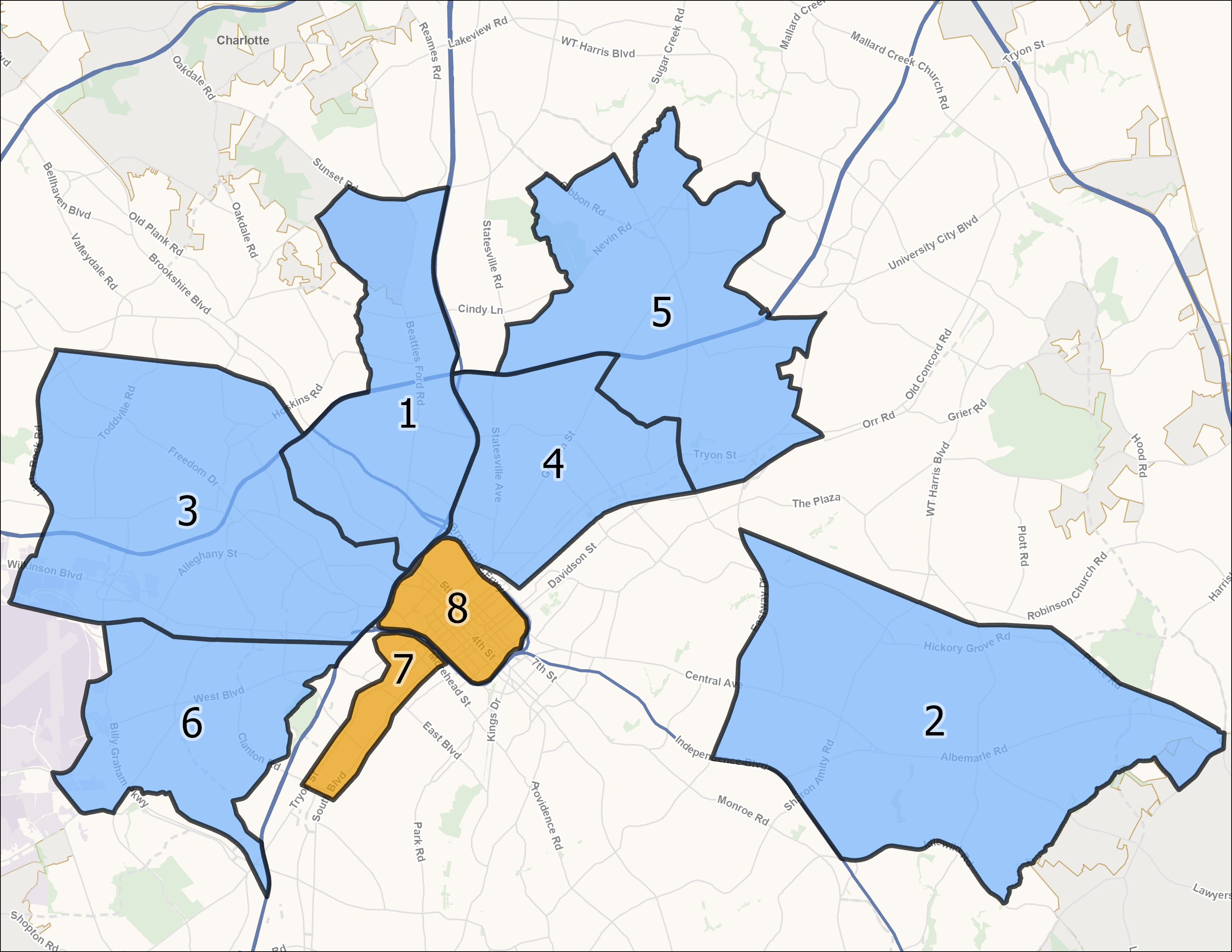
Community Access Program (CAP) Zones
| Map ID |
Zone |
Type |
| 1 |
Beatties Ford / Rozelles Ferry |
Community Access Zone |
| 2 |
Central / Albemarle |
Community Access Zone |
| 3 |
Freedom Drive / Wilkinson |
Community Access Zone |
| 4 |
Graham Street / North Tryon |
Community Access Zone |
| 5 |
Sugar Creek / I-85 |
Community Access Zone |
| 6 |
West Boulevard |
Community Access Zone |
| 7 |
South End |
Core Service Area |
| 8 |
Uptown |
Core Service Area |
Areas 1 – 6 are Community Access Zones. Areas 7 – 8 make up the existing Core Service Area.
Community Access Zones include Beatties Ford/Rozzelles Ferry, Central/Albemarle, Freedom Drive/Wilkinson, Graham Street/North Tryon, Sugar Creek/I-85 and West Boulevard. The Core Service Area consists of South End and Uptown.
Discount Programs
The Community Access Program makes shared mobility more affordable through two types of discounts.
Community Access Zone Discount: Trips beginning in a Community Access Zone automatically receive a 30% discount. No application or enrollment is required.
Eligible Rider Discount Programs: Bird and Lime offer 50% discounted pricing for eligible riders enrolled in qualifying state, federal or local assistance programs.
Get Started
Choose Bird or Lime below to learn more about each service, apply for discounted pricing through the Community Access Program (if eligible) or download the mobile app to start riding.
Permitted Fleet Sizes
Operation Hours: 5 a.m. to 1:30 a.m.

Lime
900 e-scooters
150 e-bikes

Bird
900 e-scooters
150 e-bikes
Starting or ending a ride
- Download the app. Download the Bird or Lime mobile app from the App Store or Google Play to get started.
- Use the operator's mobile app to find and unlock an e-scooter or e-bike near you.
- Ride safely and responsibly in accordance with all rules and regulations.
- When you finish your ride, end your trip using the mobile app and park the e-scooter or e-bike upright ensuring no sidewalks, curb ramps, or travel lanes are blocked. Use a micromobility parking corral when it’s available.
Contacting e-scooter & e-bike vendors to share feedback or report an issue
Bird and Lime are authorized to operate shared e-scooters and e-bikes in Charlotte. If you need to report an issue, such as an improperly parked e-scooter or e-bike, please contact the appropriate operator directly.
Under the city's permit requirements, operators must respond to reports of improperly parked devices by correcting the parking or removing the device within two hours of receiving notification.
Bird
Lime
Safety guidance
Safety for all users of the transportation network — pedestrians, bicyclists, transit riders, drivers, and shared mobility users of e-scooters and e-bikes — is the first and foremost concern of the city. City Council adopted rules for the use of e-scooters and e-bikes within Charlotte, which are detailed in Chapter 14 of Charlotte's code of Ordinances. Additional safety guidance is detailed below.
- General
- Watch out for pedestrians.
- Obey all traffic laws (e.g. ride on the right side of the road, follow traffic signals and stop signs).
- Always ride sober.
- Check carefully for motorists before merging with and crossing traffic.
- All shared mobility operators in Charlotte require riders to be at least 18 years old with a valid driver's license.
- Speed Limits: E-scooters are automatically limited to 15 mph and e-bikes are limited to 20 mph.
- Sidewalk Riding: Sidewalk riding is allowed throughout Charlotte, except in the area of Uptown bound by Church Street, Brooklyn Village Avenue, College Street, and Seventh Street. When riding on sidewalks, always be visible, courteous and yield to pedestrians.
- Parking: When you finish your ride, make sure you park your e-scooter or e-bike in a location that does not impede a pedestrian walkway. E-scooters and e-bikes cannot be parked in a manner that blocks sidewalks, curb ramps, or bus stops. Use a micromobility parking corral when it’s available.
- Helmet Use: In concurrence with state law, anyone under the age of 16 must wear a helmet. It's recommended to always wear a helmet; it's the safest way to ride an e-scooter or e-bike. (NOTE — All shared mobility operators in Charlotte require riders to be at least 18 years old with a valid driver's license).
Parking an e-scooter or e-bike
DO
- Park an e-scooter or e-bike in a location that does not impede a pedestrian walkway. When parking your e-scooter, please remember that someone using a wheelchair, or a stroller should always have plenty of room to get through.
- Park an e-scooter or e-bike upright.
- Leave a minimum 4' pathway for pedestrians when parking an e-scooter or e-bike.
- Park an e-scooter or e-bike within a bike rack when available.
- Park an e-scooter or e-bike within a parking corral, designated with pavement markings or signage.
DO NOT
- Do not block sidewalks, shared paths, or outdoor dining areas.
- Do not block public transit zones like bus stops/shelters, light rail stations, or streetcar stops.
- Do not block loading zones.
- Do not block accessible parking spaces or loading areas.
- Do not block street furniture like benches or on-street parking meters and pay stations.
- Do not block curb ramps or pedestrian signal pushbuttons.
- Do not block braille signs or drinking fountains.
- Do not block entryways, exits (keep 10-foot clearance), or driveways.
- Do not park on private property, county parks, or in vehicle or bike lanes.
Micromobility parking corrals
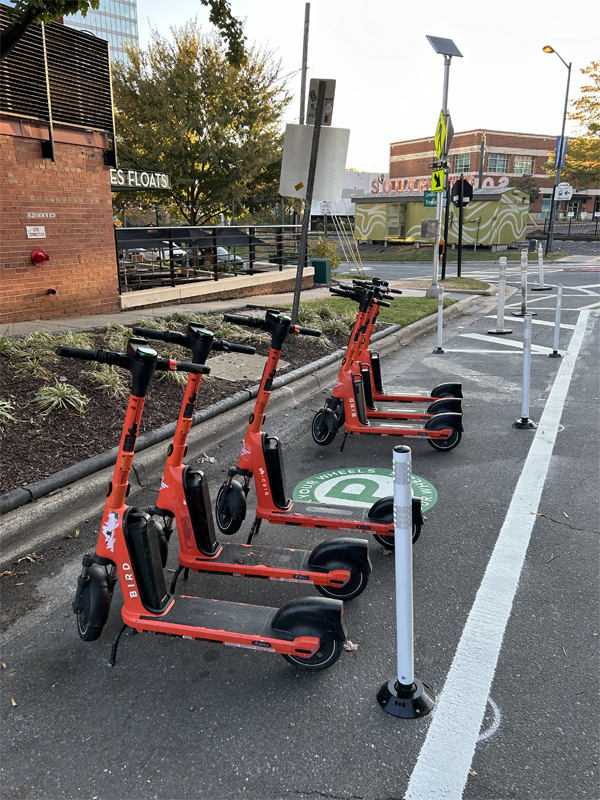
A key goal of the Shared Mobility Program is improving right-of-way management through a growing network of micromobility parking corrals, which are dedicated parking spaces for e-scooters and bikes. These parking corrals consist of pavement markings, signage, and other elements and may be placed in-street or behind the curb.
CDOT is actively expanding the city's network of micromobility parking corrals, prioritizing locations with the highest demand for shared mobility parking. Bird and Lime identify corrals as designated parking locations within their mobile applications, encourage riders to park there whenever one is available, and are directed to deploy shared mobility devices in corrals whenever practical.
Micromobility parking corrals are intended to accommodate privately owned scooters, bikes and other micromobility devices, in addition to shared mobility devices from Bird and Lime. Where possible, CDOT is working to install bike racks in existing and future parking corrals to improve safety and security for privately owned devices.
Here is an example of a parking corral along Tremont Avenue in South End:
No sidewalk riding zone

Bicycles and scooters are not allowed on sidewalks in the area between Church Street, Brooklyn Village Avenue, College Street, and Seventh Street.